
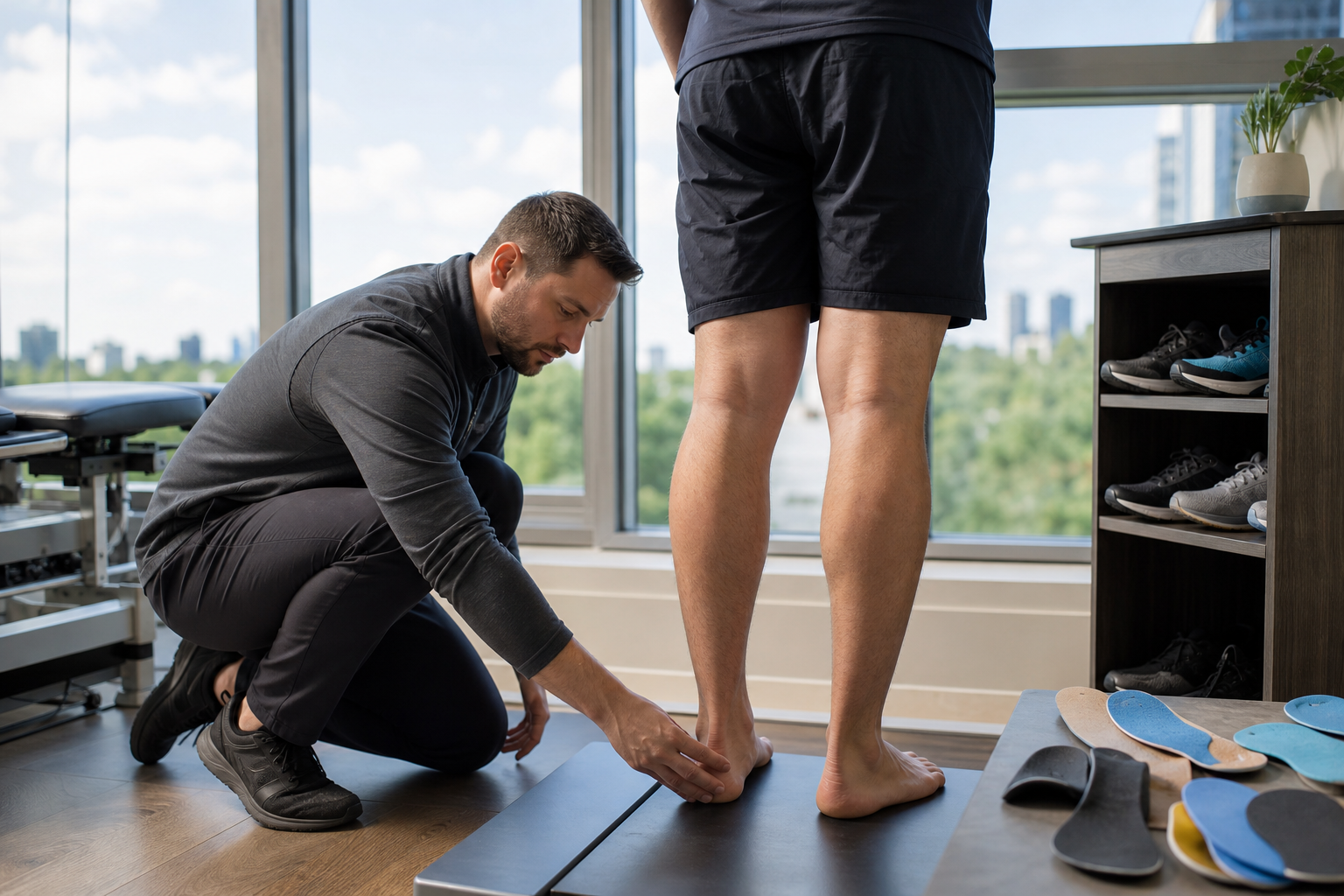
Custom Orthotics in London: How to Compare Assessment, Fit, and Follow-Up
Choosing custom orthotics in London should begin with an individualized lower-limb assessment, not an assumption that a customized insert is automatically the best choice. Your foot concerns, walking needs, activities, footwear, and assessment findings all matter.
This guide compares custom orthotics with general shoe inserts and supportive footwear. It also explains what a credible fitting process should include, which questions to ask before ordering, and what payment details to clarify in London, Ontario.
Custom orthotics, inserts, or supportive footwear: what are you actually choosing?
These options are related, but they are not interchangeable. Custom orthotics are made or selected following an assessment of your lower limbs and intended use. General inserts are pre-made products with standardized shapes and materials. Supportive footwear is designed to provide structure, stability, accommodation, or comfort through the shoe itself.
| Option | What it involves | Questions to consider |
|---|---|---|
| Custom orthotics | Individualized recommendations and fitting based on an assessment. | What concern is being addressed? Will the orthotic fit the shoes you actually wear? |
| Off-the-shelf inserts | A standardized product available without an individualized fitting process. | Does its shape, size, and firmness suit your needs and footwear? |
| Supportive footwear | Shoes selected for structure, stability, accommodation, or activity demands. | Could footwear alone be more practical than adding an insert? |
There is no universal rule that custom orthotics are better than general inserts or supportive shoes. The appropriate option depends on what you are trying to manage, how you move, what shoes you need to wear, and what an assessment identifies. A professional should explain alternatives rather than treat customization as the only answer.
When a professional lower-limb assessment may be worth considering

An assessment may be useful when foot pain, walking difficulty, an injury, or lower-limb concerns are affecting daily activities. Foundation Physiotherapy and Rehab’s pedorthic service identifies foot pain, walking difficulties, arthritis, diabetes-related foot concerns, sports injuries, and everyday activity needs as reasons someone may seek lower-limb support.
These concerns do not automatically mean that custom orthotics are necessary. They indicate that a closer discussion may help you understand whether custom inserts, general inserts, supportive footwear, bracing, compression, or another approach is relevant to your situation.
Assessment may also be worthwhile when a product you already use is uncomfortable, does not fit your shoes, or does not work well for the activities you need to perform. Keep the focus on function: walking, standing, work, sport, exercise, or daily tasks.
What a credible assessment and fitting process should include
A responsible process should be more detailed than choosing an insert from a brief visual check. It should give you an opportunity to describe your concerns, activity demands, footwear, previous devices, and practical priorities before recommendations are made.
1. Lower-limb and movement assessment
The clinic’s verified service information describes lower-limb biomechanical analysis, evidence-based assessment, and individualized recommendations. The assessment should consider relevant aspects of how your feet and lower limbs function while connecting findings to your actual goals and activities.
2. Discussion of your footwear and routines
A recommendation is more useful when it reflects the shoes you can realistically wear. Tell the provider whether you need support for work shoes, athletic shoes, everyday footwear, specialized shoes, or more than one type. Also explain how much time you spend standing, walking, running, or participating in other activities.
3. Clear comparison of options
Ask what the assessment suggests and why. A good conversation should distinguish between custom orthotics, off-the-shelf inserts, supportive footwear, bracing, or no device at this stage. It should also explain practical limitations, such as whether a product can be transferred between shoes.
4. Precise fitting and practical instructions
Fit involves more than whether an insert technically sits inside a shoe. The provider should discuss shoe compatibility, positioning, comfort, use in different activities, and what to do if the device feels unsuitable. For more information about lower-limb assessment, custom inserts, supportive footwear, and adjustments, review the clinic’s custom orthotics and pedorthic services.
5. Follow-up and adjustment planning
The clinic describes ongoing support and adjustments as part of its pedorthic service. Before proceeding, ask how follow-up works, what concerns should prompt you to contact the provider, and whether adjustments are handled as part of the service or separately.
Why footwear compatibility matters as much as the insert
Even a carefully selected orthotic has to work within the shoes you wear. A narrow or shallow shoe may not accommodate the same device as a roomy walking shoe. Athletic footwear, work boots, dress shoes, and specialized shoes can each create different fitting considerations.
Bring the shoes you use most often, or ask which footwear would be useful to bring to an assessment. If you need support across several activities, discuss whether one device can reasonably be used in different shoes or whether footwear-specific advice is more appropriate.
Supportive footwear may sometimes be a practical part of the recommendation rather than an afterthought. The clinic’s verified pedorthic information includes specialized shoes and supportive footwear designed to accommodate custom orthotics and provide stability. That does not mean a particular shoe or orthotic will suit everyone, so recommendations should remain individualized.
Fit, comfort, and adjustments: what to clarify after fitting
Comfort should be treated as something to discuss and monitor, not something to assume. Ask how the provider wants you to use the orthotics initially, what sensations should be reported, and how to distinguish a normal fitting question from a problem needing attention.
It is also reasonable to ask how the device will be reviewed if your activities, footwear, symptoms, or mobility needs change. Ongoing support gives you a way to raise practical concerns instead of abandoning the device or making changes without guidance.
A provider should not promise a specific pain, performance, or injury-prevention outcome. The more useful commitment is a clear process for assessment, fitting, communication, and adjustment based on your circumstances.
Questions to ask before booking custom orthotics in London
- Who will perform the assessment, and what credentials or training do they hold?
- Will the assessment consider my lower limbs, walking or activity demands, and current footwear?
- What alternatives should I consider, including supportive footwear or a general insert?
- What information would make custom orthotics appropriate or inappropriate for me?
- Can the recommended orthotics fit the shoes I wear for work, sport, and daily activities?
- What should I bring to the assessment, such as commonly worn shoes, previous devices, or relevant reports?
- How are fitting concerns, discomfort, or changes in use handled after delivery?
- Are follow-up appointments or adjustments included, and are there separate fees?
- What documentation can the provider supply for my insurer, employer benefit plan, WSIB, VAC, or another payer?
- What is the total price, and when is payment due?
These questions help you compare the quality of the process rather than focusing only on the word “custom.” They also make it easier to identify whether the service fits your footwear, budget, and daily routine.
Payment and coverage questions to clarify before ordering
Do not assume that custom orthotics are covered simply because they are prescribed or professionally fitted. The cited Ontario schedule information states that custom-made and off-the-shelf orthotics are not covered under the referenced Assistive Devices Program information. You can review the Ontario schedule information about orthotics and related devices for the stated limitation.
Other payment arrangements may have different rules. Before ordering, check your private insurance policy, employer benefits, WSIB claim requirements, Veterans Affairs Canada coverage, or another applicable plan. Ask what type of assessment, prescription, receipt, provider credential, or supporting documentation your plan requires.
Because eligibility and reimbursement vary, confirm details with both the provider and the payer before committing to an order. Avoid relying on a verbal assumption about coverage when written benefit rules or pre-authorization may be required.
A practical next step for comparing custom orthotics in London
If you are unsure whether custom orthotics, general inserts, supportive footwear, or another option makes sense, start with a conversation focused on your actual needs. Prepare a short description of your concern, the activities or shoes affected, any devices you currently use, and the payment plan you may rely on.
Foundation Physiotherapy and Rehab provides pedorthic services at Unit 100, 540 Wharncliffe Road South in London, Ontario. Its service information states that care is provided by a Canadian Certified Pedorthist and Registered Kinesiologist, with lower-limb assessment, individualized recommendations, precise fitting, and ongoing support and adjustments. The clinic also offers a complimentary 10–15 minute consultation for prospective patients.
Frequently asked questions
Are custom orthotics always better than off-the-shelf inserts?
No. Custom orthotics involve individualized assessment and fitting, while off-the-shelf inserts are standardized and may be appropriate for some situations. The right comparison depends on your concerns, footwear, activity demands, and assessment findings.
What should I bring to a custom orthotics assessment?
Bring the shoes you wear most often for work, exercise, sport, or daily activities. It may also help to bring previous inserts or orthotics and relevant information about symptoms, walking difficulties, injuries, or mobility goals.
Can custom orthotics fit in everyday and athletic shoes?
It depends on the design, shoe shape, available space, and activity involved. Discuss your footwear before ordering and ask whether one device can be used across your main shoes or whether different footwear recommendations are needed.
Does Ontario’s Assistive Devices Program cover custom orthotics?
The cited Ontario schedule information states that custom-made and off-the-shelf orthotics are not covered under that referenced program information. Other plans, including private insurance, WSIB, VAC, or employer benefits, may have different requirements, so verify coverage directly.
How do I know whether I need custom orthotics or supportive footwear?
An assessment can help compare the options. Explain what you need to do, which shoes you wear, and what concerns are limiting you. The recommendation may involve custom orthotics, supportive footwear, both, a general insert, or no device at that time.
Conclusion: choose the assessment that matches your needs
Custom orthotics in London should be considered as one option within a broader lower-limb and footwear assessment. Compare the quality of the evaluation, explanation of alternatives, compatibility with your shoes and activities, fitting process, follow-up support, and payment requirements before ordering.
If you want to discuss whether a full assessment is appropriate, Foundation Physiotherapy and Rehab offers a complimentary 10–15 minute consultation and pedorthic services in London, Ontario, including lower-limb assessment, custom inserts, supportive footwear, and ongoing adjustments.