
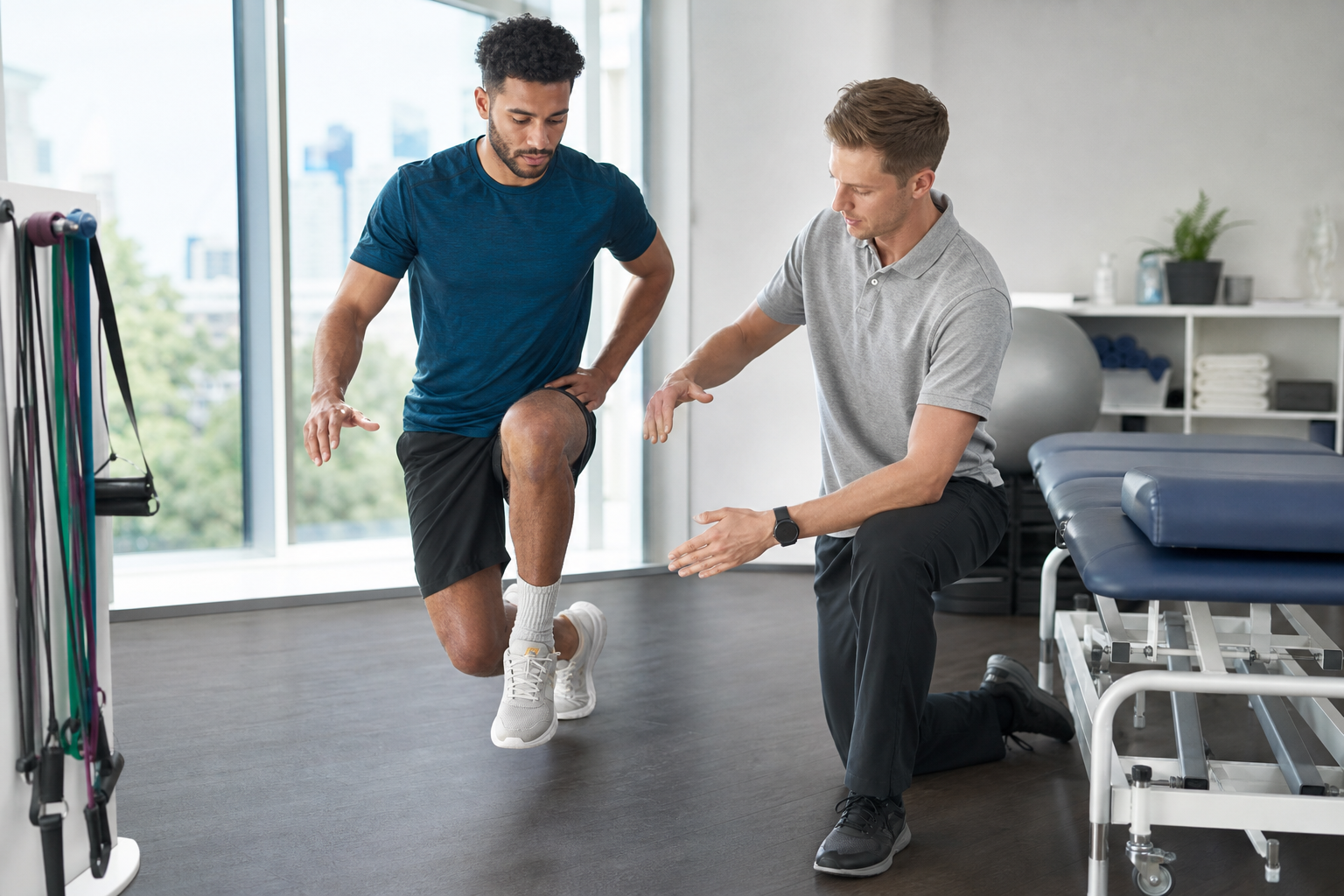
Sports Injury Rehab Protocols Explained: How Personalized Return-to-Sport Plans Work
Sports injury rehab protocols are structured, individualized plans that guide recovery from the first assessment through a return to training, work, or sport. They are not rigid exercise sheets or universal timelines. A useful protocol changes according to the injury, symptoms, treatment history, movement capacity, daily demands, and the requirements of the athlete’s sport.
The central question is not simply, “How long has it been?” It is whether the athlete can meet the physical and functional demands of the next stage without an unacceptable symptom response. This article explains what a protocol should address and when an individualized sports injury physiotherapy assessment may be appropriate.
What sports injury rehab protocols actually mean
A sports injury rehab protocol is a plan for making informed recovery decisions. It identifies what needs to improve, how progress will be monitored, which activities may need modification, and what findings support moving to a more demanding stage.
For one athlete, the main focus may be restoring joint movement after an injury. For another, it may involve rebuilding strength, improving balance, managing pain, or gradually tolerating running and changes of direction. After surgery, the protocol must also respect the surgeon’s instructions and the specific procedure. Ontario describes physiotherapists as regulated professionals who assess, treat, and rehabilitate physical dysfunction, injury, or pain. Learn more about the scope of physiotherapy in Ontario.
This is why a protocol should be treated as a decision-making framework rather than a promise of a particular recovery date. It should evolve as the athlete’s symptoms and function change.
What a protocol needs to account for

Two people with the same broad injury label may need different rehabilitation plans. A protocol should consider:
- The injury and its severity: A mild strain, significant ligament injury, fracture, or post-operative condition may require very different restrictions and progressions.
- Current symptoms: Pain, swelling, stiffness, weakness, instability, fatigue, or altered sensation can affect what is appropriate next.
- Movement and strength: Rehabilitation may need to address control, coordination, mobility, force production, and tolerance to repeated effort.
- Daily function: Walking, stairs, work tasks, sleep, and ordinary household activities provide useful context before sport-specific demands are added.
- Sport requirements: Running speed, jumping, landing, rotation, balance, endurance, contact, reaction time, and training volume may all matter.
- The athlete’s goals: Returning to recreational activity is a different target from returning to competitive play, a particular position, or a demanding work role.
Individualized rehab plans should reflect the specific injury or surgery, follow relevant clinician instructions, monitor symptoms, define goals, and establish criteria for progression. These principles for individualized rehab plans are useful even when the injury is not surgical.
The core stages of sports injury rehabilitation
Rehabilitation stages often overlap. An athlete may continue strength work while beginning sport-specific drills, or return to some activities while still modifying others. The sequence and pace should depend on the individual response rather than a fixed template.
1. Assessment and goal setting
An assessment should clarify what the athlete can and cannot do, what symptoms are present, how the injury occurred, what treatment has already taken place, and what return goal matters most. It should also consider relevant medical history and the demands of the athlete’s usual activity.
A useful goal is more specific than “get better.” It might involve tolerating a work shift, walking without a meaningful change in symptoms, completing a training activity, or performing sport-relevant movements with appropriate control. The exact measures depend on the injury and the person.
2. Restoring movement, control, and capacity
Early rehabilitation may focus on symptom-aware movement and restoring the ability to perform daily tasks. As tolerance improves, the plan may include progressive exercise, strength, coordination, balance, and conditioning. The purpose is not simply to make an exercise harder. It is to build the capacity needed for the next meaningful activity.
Exercise selection and dosage should be individualized. A general exercise found online may be unsuitable for a particular injury, stage of healing, or medical history. The athlete should understand which symptoms to monitor and how the plan will be adjusted if the response is not as expected.
3. Reintroducing sport-specific demands
General improvement does not automatically mean readiness for the athlete’s sport. A return-to-sport plan may need to reintroduce speed, changes of direction, jumping, landing, throwing, kicking, contact, visual demands, reaction, endurance, or repeated efforts.
The most relevant demands depend on the activity and the athlete’s role. A recreational runner, goalkeeper, hockey player, dancer, and weightlifter may all need different tests of readiness. For athletes recovering from concussion, return-to-sport protocols should progressively reintroduce sport-specific activity only when symptoms allow. Concussion rehabilitation may also involve vestibular, visual, cervical, headache, fatigue, and cognitive considerations.
How to decide whether to progress or pause
Progression should be based on a combination of factors, not one isolated sign. Before increasing activity, discuss whether the athlete can:
- Perform the current level of activity with a manageable and expected symptom response.
- Complete relevant movements with appropriate control and without a meaningful deterioration in quality.
- Meet the strength, mobility, balance, coordination, or conditioning demands required for the next stage.
- Manage ordinary daily activities while maintaining a stable overall pattern of symptoms.
- Describe the next activity clearly, including its speed, volume, intensity, contact, or environmental demands.
- Approach the activity with reasonable confidence rather than feeling unable to control the movement.
A pause does not necessarily mean that rehabilitation has failed. It may mean the workload increased too quickly, the current stage needs more time, or the plan needs reassessment. Worsening or persistent symptoms should be discussed with a qualified professional rather than ignored in order to meet an arbitrary date.
Why time alone does not decide return to sport
Elapsed time can help organize a plan, particularly when healing restrictions or post-operative instructions apply. However, time does not show whether an athlete has regained the movement, strength, control, confidence, and sport-specific tolerance required for participation.
Returning solely because a certain number of days or weeks has passed can overlook important differences in injury severity, treatment, symptoms, training history, and sport demands. The useful question is whether the next demand is supported by the current clinical and functional picture.
Self-directed recovery or structured rehabilitation?
Self-management may be reasonable for a minor issue that is clearly improving and does not significantly limit function. Even then, improvement is not automatic permission to immediately resume every aspect of training.
| Self-directed recovery may be reasonable when | Individualized rehabilitation may be more appropriate when |
|---|---|
| Symptoms are mild, stable, and steadily improving. | Symptoms persist, worsen, or repeatedly return with activity. |
| Daily activities remain manageable. | There is meaningful loss of movement, strength, balance, or function. |
| The injury and activity modifications are well understood. | The diagnosis or safe loading level is unclear. |
| There is no surgery or complex medical history affecting progression. | The athlete is recovering after surgery or has experienced repeated setbacks. |
| The return goal is modest. | The athlete needs a structured return-to-sport, work, or competition plan. |
This comparison is not a diagnosis or clearance checklist. It helps identify when a general online protocol is unlikely to answer an athlete’s specific questions.
Questions to ask before starting or advancing a protocol
- What is the working explanation for the symptoms?
- Which activities should be modified for now?
- Which symptoms should be monitored during and after activity?
- What daily-function goals should come before full sport participation?
- What findings support progressing to the next stage?
- What would require a pause or reassessment?
- How will my actual sport, position, event, or training schedule be reintroduced?
When to seek an individualized sports injury assessment
Consider professional assessment when symptoms are not improving as expected, ordinary activity remains difficult, the injury keeps recurring, or you are unsure how to load the affected area. Assessment is also appropriate after surgery, when a previous plan has stalled, or when returning to a high-demand sport requires more than general strengthening.
A regulated physiotherapist can connect symptoms and functional limitations with practical rehabilitation goals. The aim is not to force a particular timeline, but to make the next decision more informed.
How concussion rehabilitation differs from other sports injuries
Concussion rehabilitation requires its own clinical considerations. Symptoms may involve balance, vision, the neck, headaches, fatigue, cognition, school, work, and sport participation in different ways.
Foundation Physiotherapy and Rehab states that its concussion rehabilitation supports adults, teenagers, and children with structured return-to-school, return-to-work, and return-to-sport programs. That context should not be generalized to every sports injury.
Choosing the right next step in London, Ontario
For an athlete in London, Ontario, the right next step depends on the injury, current function, and uncertainty involved. Foundation Physiotherapy and Rehab provides one-on-one orthopedic and musculoskeletal physiotherapy for pain, injuries, post-surgical rehabilitation, and movement recovery.
The clinic also provides functional rehabilitation focused on return-to-work, function, conditioning, and resilience. Its website describes a complimentary 10 to 15 minute consultation for prospective patients. Confirm current availability, fees, and suitability with the clinic.
Frequently asked questions
How long does a sports injury rehab protocol take?
There is no single appropriate timeline. Duration depends on the injury, severity, treatment or surgery, symptoms, function, sport demands, and response to progressive activity.
Can I follow a protocol without seeing a physiotherapist?
Some minor, improving problems may be manageable with appropriate activity modification. Professional assessment is more important when symptoms persist, function is limited, the diagnosis is unclear, or the injury followed surgery.
What should I do if symptoms return when I increase activity?
Pause the progression and review what changed, including intensity, volume, speed, contact, recovery, and other life demands. Seek reassessment if symptoms persist, recur, or meaningfully affect function.
How do return-to-sport protocols differ after a concussion?
They may account for balance, vision, neck symptoms, headaches, fatigue, cognition, school, work, and sport-specific activity. Progression should be structured and symptom-aware.
Does sports injury rehabilitation include strength and conditioning?
It can include progressive strength, movement control, conditioning, and sport-specific loading when those elements fit the injury and the athlete’s goals.
Conclusion: use the protocol to guide decisions, not replace assessment
Sports injury rehab protocols connect injury assessment to symptom monitoring, daily function, progressive capacity, and the real demands of sport. They provide a framework for deciding what to do next, but they cannot replace individualized assessment or guarantee a return date.
If progress is unclear, symptoms persist, or activity repeatedly causes setbacks, seek professional guidance before advancing. In London, Ontario, Foundation Physiotherapy and Rehab provides one-on-one physiotherapy and rehabilitation services.