
Physiotherapy in London, Ontario: What It Can Help With and How to Choose Care
Physiotherapy can help with more than a sore back or sports injury. In Ontario, physiotherapists assess, diagnose, treat, and rehabilitate physical dysfunction, injury, and pain while helping people maintain or improve mobility. In practical terms, that may include restoring movement after surgery, managing persistent pain, improving balance, supporting pelvic health, or rebuilding function for work and daily life.
The most useful first decision is not simply finding a physiotherapist. It is matching your main concern and goals to the right care stream, then choosing a clinic that will assess your situation thoroughly and explain the next steps clearly.
Key Takeaways
- Physiotherapy addresses pain, injury, reduced mobility, movement dysfunction, balance concerns, and functional limitations.
- Orthopedic and musculoskeletal care may fit back or neck pain, joint problems, tendon injuries, sports injuries, chronic conditions, and post-surgical recovery.
- Pelvic health, vestibular, concussion, TMJ, pedorthic, and functional rehabilitation provide more targeted assessment for specific concerns.
- When comparing clinics, look for relevant experience, one-on-one attention, clear communication, personalized exercises, and a plan connected to your goals.
- Foundation Physiotherapy and Rehab offers a complimentary 10–15 minute consultation at its London clinic to help prospective patients understand an appropriate next step.
Quick summary

- Physiotherapy addresses pain, injury, reduced mobility, movement dysfunction, balance concerns, and functional limitations.
- Orthopedic and musculoskeletal care may fit back or neck pain, joint problems, tendon injuries, sports injuries, chronic conditions, and post-surgical recovery.
- Pelvic health, vestibular, concussion, TMJ, pedorthic, and functional rehabilitation provide more targeted assessment for specific concerns.
- When comparing clinics, look for relevant experience, one-on-one attention, clear communication, personalized exercises, and a plan connected to your goals.
- Foundation Physiotherapy and Rehab offers a complimentary 10–15 minute consultation at its London clinic to help prospective patients understand an appropriate next step.
What physiotherapy in London, Ontario can help with
Physiotherapy is a form of rehabilitation focused on how your body moves and functions. Treatment may be relevant when pain, injury, weakness, stiffness, poor balance, or another physical concern makes it harder to work, exercise, sleep, care for yourself, or participate in everyday activities.
Depending on the concern, care may include clinical assessment, hands-on treatment, movement retraining, therapeutic exercise, education, and a home program. The specific approach should follow the person’s symptoms, health history, functional goals, and assessment findings rather than a one-size-fits-all routine.
In London, available care may include general orthopedic rehabilitation as well as targeted services for pelvic health, dizziness and vertigo, concussion recovery, jaw dysfunction, foot mechanics, and return-to-work needs. Foundation Physiotherapy and Rehab describes its care as personalized and one-on-one. Ontario’s description of the physiotherapy profession is available at the provincial regulated health professions page.
Match your concern to the right physiotherapy specialty

Symptoms can overlap, so this table is a starting point rather than a diagnosis. A physiotherapist can help determine which assessment is appropriate, particularly when more than one concern is present.
| Concern or goal | Care stream to ask about | Examples of what it may address |
|---|---|---|
| Pain, stiffness, injury, or reduced strength | Orthopedic and musculoskeletal physiotherapy | Back and neck pain, joint or tendon problems, sports injuries, chronic conditions, movement limitations, and post-surgical rehabilitation. |
| Leakage, pelvic pain, pregnancy-related changes, or postpartum recovery | Pelvic health physiotherapy | Incontinence, pelvic organ prolapse, pelvic pain, vaginismus, diastasis recti, and prenatal or postnatal concerns. |
| Dizziness, spinning, imbalance, or symptoms triggered by head movement | Vestibular rehabilitation | Dizziness, vertigo, BPPV, gaze or balance difficulties, and other vestibular concerns. |
| Symptoms after a concussion or difficulty returning to activity | Concussion rehabilitation | Structured recovery and gradual return-to-activity support for adults, teens, and children. |
| Jaw pain, clicking, limited opening, or headaches associated with jaw tension | TMJ physiotherapy | Jaw pain and dysfunction, bruxism, facial tension, headaches, migraines, and post-dental pain. |
| Foot, lower-limb, or footwear-related concerns | Pedorthic services | Custom orthotics, footwear support, bracing, compression stockings, and lower-limb care connected to rehabilitation needs. |
| Difficulty performing work or everyday tasks | Functional rehabilitation | Conditioning, return-to-work planning, functional capacity evaluation, and progressive rebuilding of practical function. |
When general orthopedic and musculoskeletal physiotherapy may fit
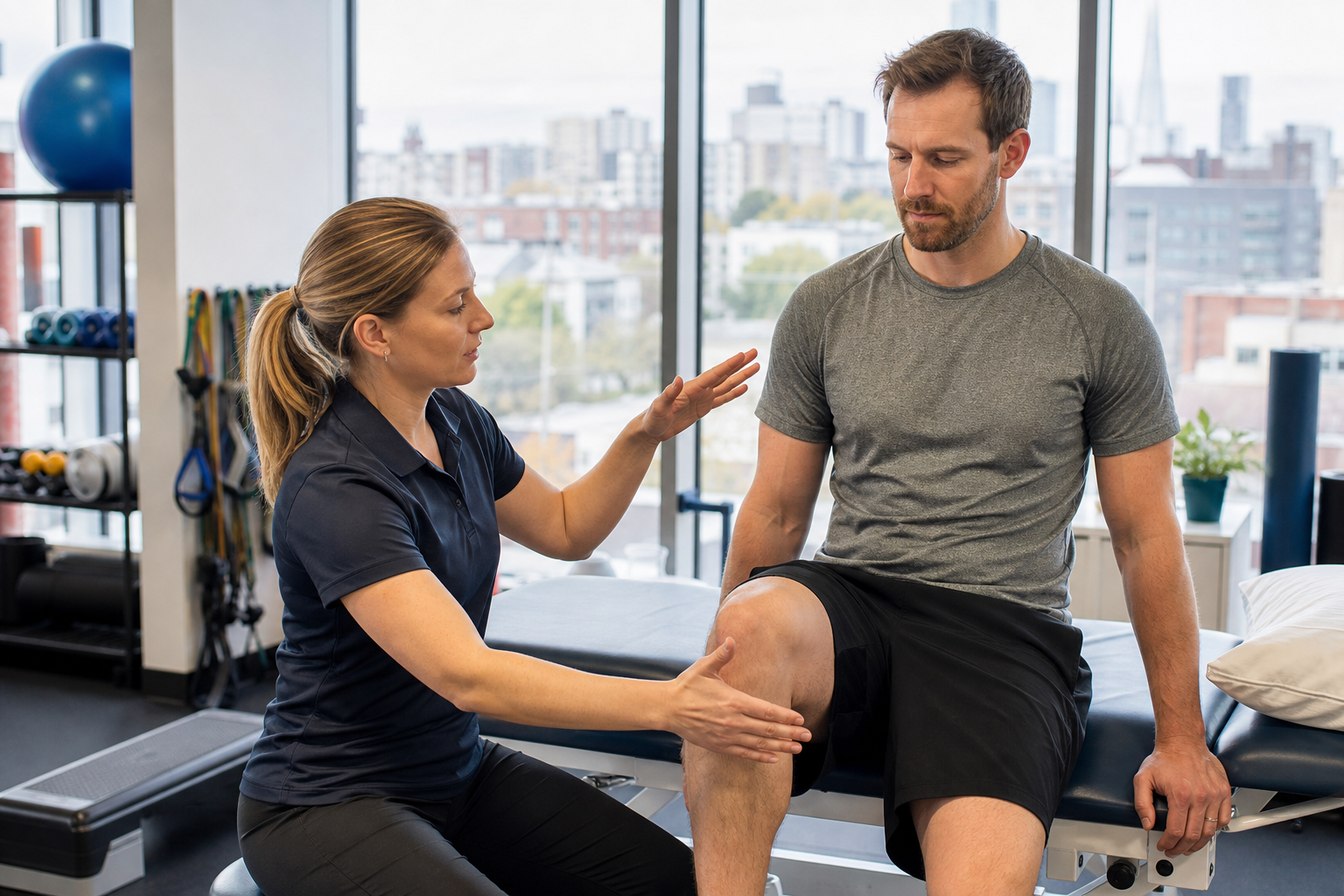
Orthopedic and musculoskeletal physiotherapy is often the relevant starting point for problems involving muscles, joints, ligaments, tendons, and nerves. It may be appropriate for a new sprain, recurring sports injury, back or neck pain, arthritis-related limitations, repetitive strain, or rehabilitation after an orthopedic procedure.
The aim is not only to reduce symptoms during an appointment. Assessment may examine strength, mobility, movement patterns, irritability, and the activities you want to resume. Treatment can then combine manual therapy, movement retraining, progressive exercise, and education. For back pain, sports injuries, joint problems, or recovery after surgery, orthopedic physiotherapy can provide a relevant starting point.
Orthopedic care does not mean every problem should be treated with the same exercises. A post-surgical program may need to follow surgical guidance, while an overuse injury may require a different approach to loading and activity. Ask how the plan will be adjusted as your function changes.
When a specialized rehabilitation stream may be more appropriate
Some concerns benefit from an assessment designed around a particular body system or activity. Leakage, pelvic pain, or pregnancy-related changes may warrant pelvic health physiotherapy rather than a general strengthening routine. Room-spinning dizziness or symptoms brought on by rolling in bed may call for vestibular assessment. Jaw pain with clicking, limited opening, or headaches may be better addressed through TMJ-focused care.
Concussion rehabilitation also requires attention to symptoms and tolerance as a person returns to school, work, sport, or other activity. Similarly, someone whose primary goal is safely resuming job duties may need functional rehabilitation rather than treatment focused only on pain at rest.
These categories are not always separate. A person may have a musculoskeletal injury alongside balance problems, pelvic symptoms alongside back pain, or jaw tension alongside headaches. A clinic with several relevant services may make it easier to discuss the whole picture, but the appropriate plan still depends on an individual assessment.
What to look for when choosing a physiotherapy clinic
Local search results can show many clinics, but a useful choice depends on fit rather than a generic claim that one provider is best. Before booking, consider these criteria:
- Relevant care: Does the clinic address the type of concern you want help with?
- Assessment quality: Will the first appointment include time to understand your history, symptoms, limitations, and goals?
- Individual attention: Ask whether care is delivered one-on-one and who will be directly involved.
- Clear communication: You should understand what will be assessed and what you can do between visits.
- Personalized progression: Exercises should suit your current ability and change as your function changes.
- Practical fit: Confirm location, appointment process, fees, and documentation requirements directly.
What an initial consultation can and cannot do
A short consultation can be useful when you are unsure whether a clinic addresses your concern or which service to request. Foundation Physiotherapy and Rehab offers a complimentary 10–15 minute consultation for prospective patients. This creates an opportunity to describe the main issue, ask whether the clinic may be an appropriate fit, and clarify what a full appointment would involve.
However, a brief consultation should not be treated as a full assessment, diagnosis, or treatment session. Bring a concise description of what started the problem, what makes it better or worse, which activities are affected, and what you hope to regain.
A short checklist before contacting a London physiotherapist
- What is the main problem, and when did it begin?
- Which activities are limited?
- Have I had an injury, surgery, concussion, pregnancy-related change, or dental procedure connected to the symptoms?
- Does the clinic offer a care stream that matches my concern?
- Will my care be one-on-one, and who will perform the assessment?
- What should I expect during the first full appointment?
- What are the fees, booking steps, and documentation requirements?
A local option for one-on-one physiotherapy in London
Foundation Physiotherapy and Rehab provides one-on-one physiotherapy and rehabilitation across pelvic health, orthopedic and musculoskeletal care, vestibular rehabilitation, concussion rehabilitation, TMJ physiotherapy, acupuncture and dry needling, functional rehabilitation, pedorthic services, B-Pulse chair therapy, and assistive-device and mobility assessments.
The clinic is located at Unit 100, 540 Wharncliffe Road South, London, Ontario N6J 2N4. Its range of services may be useful for people who are still clarifying which care stream fits their symptoms, particularly when concerns overlap.
Frequently asked questions about physiotherapy in London, Ontario
Can physiotherapy help if I am not sure what is causing my pain?
It may be appropriate to begin with a physiotherapy assessment when pain or reduced movement is affecting daily activities. The clinician can review your history and movement, explain what may need further investigation, and recommend an appropriate direction.
Which type of physiotherapy is appropriate for dizziness or BPPV?
Vestibular rehabilitation is the care stream to ask about for dizziness, vertigo, BPPV, and balance concerns. Tell the clinic what triggers the symptoms so the assessment can be planned appropriately.
When should I look for pelvic health physiotherapy in London?
Consider asking about pelvic health physiotherapy for incontinence, pelvic pain, pelvic organ prolapse, pregnancy-related changes, postpartum concerns, vaginismus, diastasis recti, or related bladder and bowel difficulties.
What should I ask during a physiotherapy consultation?
Ask whether the clinic treats your concern, what the first appointment includes, who will assess you, how care is individualized, and what information you should bring. Also ask about fees and scheduling.
Can one physiotherapy clinic address more than one related concern?
Some clinics offer several rehabilitation streams, which can be convenient when symptoms overlap. Foundation Physiotherapy and Rehab provides services spanning pelvic health, orthopedic, vestibular, concussion, TMJ, functional, pedorthic, and mobility-related care.
Choose care that matches your concern and goals
Physiotherapy in London, Ontario can address pain, injury, movement limitations, balance problems, pelvic health concerns, concussion recovery, jaw dysfunction, and practical work or daily-life goals. The strongest starting point is to identify the activity you want to improve, match your concern to a relevant care stream, and choose a clinic that offers thorough assessment, clear explanations, individualized exercises, and appropriate one-on-one attention.
If you are unsure where to begin, Foundation Physiotherapy and Rehab offers a complimentary 10–15 minute consultation. Learn more through Foundation Physiotherapy and Rehab.