
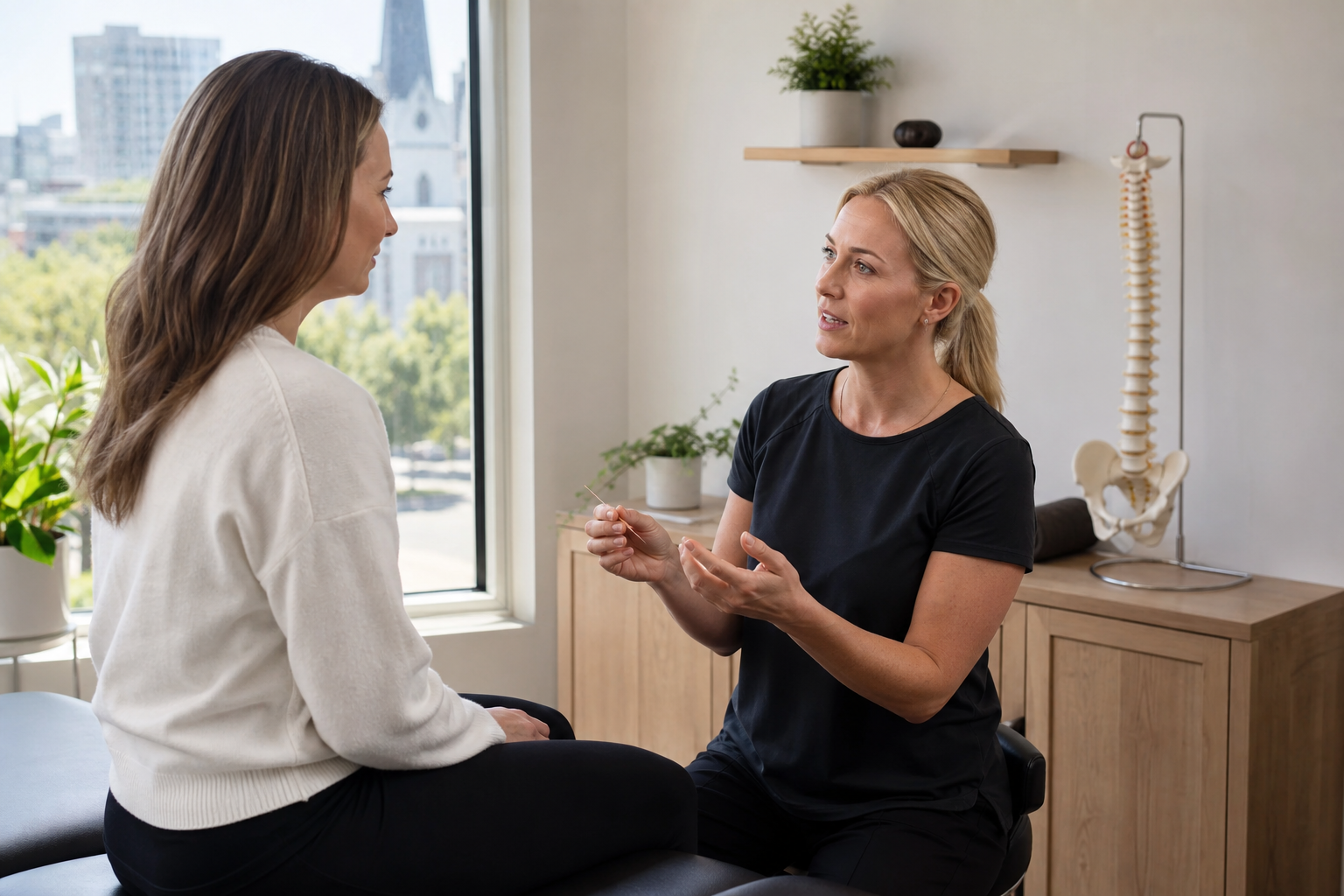
Acupuncture and Dry Needling in London: Which Approach Fits Your Goals?
Acupuncture and dry needling both use thin needles, but they are not interchangeable terms. They use different frameworks to guide treatment and may be discussed for different clinical goals. IMS, or intramuscular stimulation, is a form of dry needling associated with shortened, sensitive muscles and nerve-related pain.
The right option depends on your symptoms, movement concerns, health history, preferences, and what you want to improve. An assessment should come before choosing a technique because needle-based treatment is only one possible part of a broader rehabilitation plan.
Key Takeaways
- Acupuncture and dry needling serve different purposes despite using similar techniques.
- Individual assessments are crucial to determine the most suitable approach for your rehabilitation.
- Both techniques can be integrated into a comprehensive rehabilitation plan that includes various therapies.
- Clear communication with your physiotherapist about your goals and symptoms is essential for effective treatment.
- Foundation Physiotherapy and Rehab offers complimentary consultations to help you navigate your options.
What acupuncture, dry needling, and IMS mean
These approaches can look similar because each involves fine needles. The meaningful difference is why the practitioner selects particular points or tissues and how the technique fits your symptoms and treatment plan.
Dry needling
Dry needling is a musculoskeletal technique that targets taut bands or trigger points in muscles. A physiotherapist may use palpation and movement assessment to identify a relevant area, with the aim of addressing local muscle tension or sensitivity. A brief twitch response may occur when the needle reaches the targeted tissue.
Dry needling is commonly discussed alongside muscle tension, trigger-point-related symptoms, movement difficulty, or musculoskeletal pain. It should still be connected to an individual assessment rather than applied simply because a painful area appears on a generic body map.
IMS
IMS stands for intramuscular stimulation and is also called the Gunn technique. It is described as a form of dry needling that targets shortened, hypersensitive muscles often associated with nerve-related pain. The term therefore describes a particular clinical approach within the broader dry-needling conversation.
Traditional acupuncture
Traditional acupuncture uses needle placement along points and meridians associated with Traditional Chinese Medicine. This is a different treatment framework from dry needling’s Western neuroanatomical and musculoskeletal focus. A provider should explain what acupuncture is intended to support in your rehabilitation plan.
Foundation Physiotherapy and Rehab offers acupuncture and dry needling in London, including dry needling, IMS, and traditional acupuncture. The clinic describes these as distinct approaches that can be considered according to a person’s condition and goals.
How the approaches differ in practice

Acupuncture and dry needling may involve similar equipment, but their treatment rationale and target selection can differ. Understanding that distinction helps you ask clearer questions before consenting to a technique.
| Point of comparison | Dry needling | IMS | Traditional acupuncture |
|---|---|---|---|
| Guiding framework | Western neuroanatomical and musculoskeletal assessment | Intramuscular stimulation focused on sensitive, shortened muscles | Traditional Chinese Medicine points and meridians |
| Typical target | Taut muscle bands or trigger points | Muscles associated with nerve-related pain and sensitivity | Selected acupuncture points, which may be local or elsewhere on the body |
| Clinical discussion | Muscle tension, trigger-point symptoms, and movement concerns | Shortened or hypersensitive muscles and related pain patterns | A treatment goal explained through the acupuncture framework |
| Useful question | Which muscle or movement problem is being addressed? | Why is intramuscular stimulation relevant to my symptoms? | What is the proposed goal of acupuncture in my care? |
This comparison does not make one option universally better. Dry needling versus acupuncture is best understood as a question of clinical rationale, personal goals, comfort, and how the technique fits with the rest of rehabilitation.
Match the discussion to your symptoms and goals
Instead of starting with “Which treatment should I book?”, start with “What am I trying to change?” Your answer might involve reducing muscle tension, moving more comfortably, tolerating activity, returning to work, or managing persistent discomfort. A clear functional goal gives the physiotherapist something specific to assess and review.
Dry needling or IMS may be discussed when the assessment identifies a relevant muscular or movement concern. Acupuncture may be discussed through its own treatment framework. However, a symptom label alone does not determine which approach is appropriate, and needling may not be the main intervention recommended.
Tell the physiotherapist how symptoms behave, what activities aggravate them, what you have already tried, and what improvement would matter in daily life. This information is more useful than selecting a technique because it is popular or because a diagram appears to match your pain.
Why assessment should come before needling
A useful conversation should connect the proposed technique to your symptoms, movement, goals, health history, and preferences. It should also leave room for alternatives if needling is not appropriate or does not fit the main problem being addressed.
Before treatment, discuss the reason for the recommendation, the area or points being considered, and how the approach relates to your rehabilitation goals. You can also ask what sensations may occur, what information the practitioner needs from you, and how your response will be reviewed.
A generic trigger-point map cannot account for your full history, movement pattern, medications, previous reactions, or treatment preferences. Choosing a technique by body part alone can therefore be less useful than having a focused assessment first.
How needling can fit into a rehabilitation plan
Needling should be considered as one component of care rather than a complete plan by itself. Depending on the assessment, broader rehabilitation may include exercise, progressive loading, mobility work, manual therapy, education, and changes to activities that aggravate symptoms.
A physiotherapist may discuss dry needling for a muscular concern while also prescribing exercises that support movement and strength. The purpose is to connect each part of care to a meaningful goal and review whether the plan remains useful.
Reassessment matters because symptoms and tolerance can change. A practitioner should explain how the plan will be adjusted if the proposed approach does not support the intended functional improvement.
What to prepare before a London consultation
You do not need to arrive with a diagnosis or know which technique you want. Bring enough information for the physiotherapist to understand the problem and explain the available options.
- Your main concern: Describe where you feel symptoms, how they started if known, and what makes them better or worse.
- Your functional goal: Explain the activity you want to resume or perform more comfortably, such as work, exercise, sleep, or daily movement.
- Your symptom pattern: Note whether symptoms are constant, activity-related, changing, or associated with particular movements.
- Your health history: Share relevant conditions, previous procedures, current care, and information your provider needs to assess suitability.
- Your medications and previous reactions: Mention relevant medications, past responses to needling or other treatments, and anything that concerns you.
- Your preferences: Say if you feel uncertain about needles, want a detailed explanation, or would like to discuss alternatives.
Questions to ask before choosing an approach
- Which technique are you proposing: acupuncture, dry needling, IMS, or another treatment?
- What did you find in the assessment that makes this approach relevant?
- Which symptom or functional goal is the treatment intended to support?
- How will the technique fit with exercise, mobility work, manual therapy, or education?
- What should I expect to feel during or after treatment, and what should I report to you?
- How will we review whether the plan is helping my goals?
- What alternatives could we consider if I prefer not to have needling?
Clear answers should relate the treatment to your individual situation. If the explanation focuses only on a painful spot or a broad promise, ask how the recommendation fits your assessment and wider rehabilitation plan.
Exploring acupuncture and dry needling in London
Foundation Physiotherapy and Rehab provides acupuncture, dry needling, and IMS in London, Ontario, as part of its physiotherapy services. The clinic’s approach is one-on-one and assessment-led, with treatment discussions connected to symptoms, movement concerns, goals, health history, and preferences.
Prospective patients can request a complimentary 10 to 15 minute consultation to discuss their concerns and receive direction before starting care. A consultation can help clarify which technique is being discussed and how it may fit with a broader rehabilitation plan.
Frequently asked questions
Are acupuncture and dry needling the same treatment?
No. Both use thin needles, but dry needling is described through a musculoskeletal and Western neuroanatomical framework, while traditional acupuncture uses points and meridians associated with Traditional Chinese Medicine. They should be discussed as distinct approaches.
What is IMS in physiotherapy?
IMS means intramuscular stimulation and is also known as the Gunn technique. It is a form of dry needling that targets shortened, hypersensitive muscles often associated with nerve-related pain.
Can acupuncture or dry needling be part of a broader rehabilitation plan?
Yes, they may be considered alongside exercise, mobility work, manual therapy, education, and reassessment. Whether either technique belongs in your plan depends on your assessment, goals, health history, and preferences.
What should I tell a physiotherapist before discussing needling?
Share your main concern, symptom pattern, functional goals, relevant health history, medications, previous treatment responses, and any concerns about needles. This helps the provider explain whether a technique is relevant and what alternatives may be available.
How can I decide whether to ask about acupuncture or dry needling in London?
Start by describing what you want to improve rather than choosing a treatment label. Ask which approach is being proposed, why it fits the assessment, how it would support your goal, and how progress would be reviewed.
Choosing your next step
Acupuncture, dry needling, and IMS are related in appearance but different in rationale and application. The most useful decision is to discuss your goals, symptoms, health history, preferences, and the role of needling within active rehabilitation.
If you are considering acupuncture or dry needling in London, Ontario, Foundation Physiotherapy and Rehab offers a complimentary 10 to 15 minute consultation to help prospective patients discuss their concerns and understand possible next steps.