
ADP Mobility Funding Guide: Eligibility, Assessments, and How to Apply in Ontario
If you need a walker, wheelchair, scooter, or another mobility aid in Ontario, the Assistive Devices Program (ADP) may help with eligible equipment. However, ADP mobility funding is not automatic, and it does not cover every device, modification, accessory, or price.
This practical ADP mobility funding guide explains the usual sequence: check the general requirements, identify your daily mobility needs, complete an assessment, obtain the required authorization, confirm equipment and vendor details, and purchase only after the necessary approval. “ADP mobility funding guide” is an informal search term, not the name of one official government guide. Current rules are spread across Ontario’s mobility-aid information, ADP policies, and device-specific manuals.
Quick summary

- You generally need to be an Ontario resident with a valid Ontario health card and a disability expected to require a mobility aid for at least six months.
- The device must meet the program’s category-specific clinical and funding requirements. General eligibility does not guarantee approval.
- A mobility assessment connects your abilities, transfers, home, transportation, safety needs, and daily goals to suitable equipment.
- Do not buy equipment before confirming the required authorization and funding steps. Buying too early may make the purchase ineligible for ADP assistance.
- Verify the current rules for your exact device before making financial decisions.
What ADP mobility funding is and is not
Ontario’s ADP provides funding assistance for certain customized equipment and supplies for people with long-term physical disabilities. Mobility categories can include manual wheelchairs, power wheelchairs, power scooters, power add-ons, positioning devices, forearm crutches, adult wheeled walkers, and certain pediatric equipment. The Ontario Assistive Devices Program information explains that eligibility and funding depend on clinical criteria and program rules for the specific device.
ADP is not a promise to pay the full purchase price. The program may apply approved funding amounts, category limits, replacement rules, product requirements, and other conditions. You may still have a contribution or costs for items outside the approved funding scope, such as certain upgrades or modifications.
It is useful to separate four decisions that are sometimes treated as one:
- General eligibility: whether your circumstances appear to meet the program’s basic requirements.
- Clinical recommendation: what an assessment indicates you need for safe, functional mobility.
- ADP authorization: whether the required qualified professional documents the device and clinical rationale under the applicable rules.
- Funding approval and supply: whether the program and vendor process the selected equipment within the applicable limits.
General Ontario ADP eligibility checklist

Use this checklist as an initial screen, not as a funding decision. Ontario’s current mobility-aid information identifies these general requirements:
- You are an Ontario resident.
- You have a valid Ontario health card.
- You have a disability that requires a mobility aid for six months or longer.
- Your needs meet the clinical and device-specific criteria for the equipment requested.
The six-month requirement does not mean every person who has difficulty walking will qualify for every type of aid. The program considers the ongoing mobility need and whether the requested equipment meets its definition of basic mobility requirements. The device must also fit the program’s approved category and documentation process.
If your need is temporary, your health-card status is changing, or you are unsure whether your condition meets the program’s criteria, ask the appropriate healthcare professional or ADP contact to clarify the current requirements before ordering equipment.
Which mobility aids may be covered?
Ontario identifies several mobility-aid categories that may receive ADP assistance. Inclusion in a category does not mean that every model or feature is eligible. The following table is a starting point for discussion with an assessor and vendor.
| Mobility aid | What to clarify before choosing |
|---|---|
| Adult wheeled walker | Walking ability, balance, hand function, turning space, terrain, and daily mobility needs. |
| Forearm crutches | Weight-bearing status, upper-limb capacity, coordination, stairs, transfers, and safe technique. |
| Manual wheelchair | Propulsion, distances, seating, transfers, vehicle access, and home layout. |
| Power wheelchair | Daily mobility, driving ability, indoor and outdoor environments, charging, transportation, and seating. |
| Power scooter | Use location, turning and storage space, transfers, controls, transportation, and category criteria. |
| Power add-on | Base-equipment compatibility, safety, functional purpose, and program requirements. |
| Positioning device | Postural support, pressure management, comfort, transfers, and clinical rationale. |
| Pediatric equipment | Development, growth, home and school environments, supervision, and pediatric criteria. |
Ontario’s professional ADP materials describe the program as funding assistance for equipment that meets an applicant’s basic mobility requirements. Product codes, approved amounts, required documentation, and rules for modifications can change, so a category list should never be treated as approval of a particular product.
Why the mobility assessment comes before the application
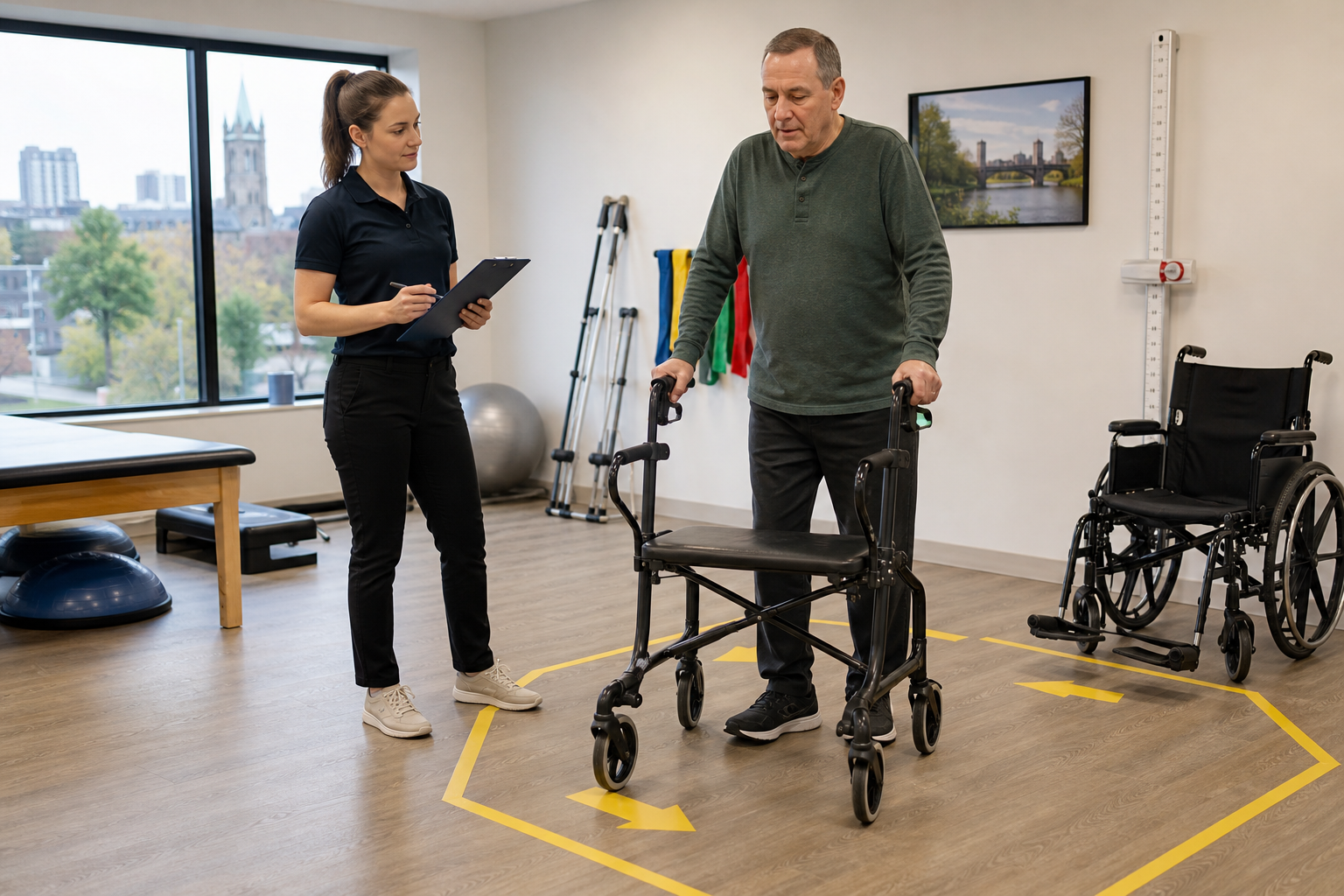
A mobility assessment examines the relationship between you, the equipment, and the environment. It may consider walking and transfer performance, balance, strength, symptoms, hand function, endurance, home barriers, transportation, and the activities you need to complete every day.
For example, a walker that works in a wide hallway may be difficult to turn in a bathroom. A wheelchair that fits indoors may not meet your outdoor, vehicle, school, or work requirements. A power device also needs to be considered alongside controls, charging, storage, ramps, transfers, and safe operation.
Before applying for ADP mobility funding, review how assistive device assessments connect your abilities, environment, safety needs, and equipment requirements. A structured trial can reveal problems with fit, comfort, propulsion, turning, transfers, or operation before you commit to a device.
The assessment should answer practical questions, such as:
- What tasks are difficult or unsafe without equipment?
- How far and how often do you need to move?
- Can you safely use the proposed brakes, joystick, controls, or supports?
- Will the equipment fit through entrances, hallways, bathrooms, and vehicle spaces?
- What help will a caregiver provide?
- What equipment is needed for home access, and what is needed for community mobility?
The ADP mobility funding process step by step
1. Describe the real mobility problem
Start with activities rather than a preferred product. Record where you struggle, such as stairs, outdoor walking, appointments, work, school, or moving safely between rooms.
2. Arrange a mobility assessment
An assessment helps determine whether a mobility aid is appropriate and what features are necessary. Bring current equipment when relevant.
3. Trial suitable equipment
Whenever possible, test equipment in conditions that resemble daily life. Check fit, posture, transfers, turning, propulsion, controls, surface changes, and storage.
4. Obtain the required clinical authorization
The qualified authorizer documents the clinical need and equipment requirements under applicable ADP rules. An assessment alone does not confirm funding.
5. Confirm vendor and equipment details
The vendor should explain the model, configuration, pricing, delivery, fitting, training, and any amount remaining your responsibility.
6. Complete the required documentation
Paperwork depends on the device and program category. Confirm who submits each document and whether approval is required before ordering.
7. Confirm approval before purchasing
Keep written confirmation of approved equipment, funding, vendor responsibilities, and your expected contribution. Ask whether changes require new authorization.
For additional points to verify, review common ADP funding navigation questions before signing a purchase agreement.
Who does what: client, authorizer, vendor, and ADP
| Participant | Main responsibility |
|---|---|
| Client or caregiver | Explain daily challenges, home conditions, goals, support, and cost questions. |
| Qualified authorizer | Assess functional needs, document the rationale, and complete the applicable authorization. |
| Vendor | Provide equipment, pricing, fitting, delivery, and supply-related information. |
| ADP | Apply Ontario’s program rules, category requirements, funding limits, and approval processes. |
These roles are not interchangeable. A clinician may recommend equipment without guaranteeing government funding, and a vendor may offer a product without confirming that it meets ADP requirements.
What to prepare for a mobility assessment
- Relevant medical, surgical, therapy, or specialist records.
- A current medication list and symptoms affecting movement, balance, or endurance.
- Your current mobility equipment, when appropriate.
- Examples of difficult or unsafe tasks, including distances and frequency.
- Notes or measurements about stairs, entrances, thresholds, bathrooms, hallways, and storage.
- Information about vehicles, public transportation, work, school, and community activities.
- Caregiver or family input, especially regarding transfers or equipment use.
- Questions about eligibility, authorization, vendors, contributions, repairs, and replacements.
The most important warning: do not buy before authorization
Do not assume that buying a device first and applying afterward will work. Ontario guidance states that equipment purchased before it is authorized may not receive ADP funding assistance.
Before paying a deposit or signing an order, confirm whether authorization must be completed first, whether the exact model and configuration have been documented, whether the vendor is following the ADP process, and what happens if the application is declined or modified.
Review ADP funding red flags to watch for when comparing recommendations or purchase arrangements.
Costs, contributions, and funding limitations
There is no single contribution percentage or universal price rule for every mobility aid. Costs may depend on the device category, approved amount, clinical criteria, configuration, modifications, accessories, vendor pricing, and items outside the program.
Ask for an itemized explanation of the requested equipment, possible ADP funding, your expected contribution, optional upgrades, delivery and fitting charges, and repair, maintenance, battery, replacement, and warranty responsibilities.
Check Ontario’s official mobility-aid and ADP pages for current information, especially when product manuals or funding policies have changed.
Practical next steps for London residents
If you live in London, Ontario, write down the mobility tasks limiting your safety or independence. Gather records, equipment information, home measurements, and funding questions before arranging an assessment.
Foundation Physiotherapy and Rehab provides assistive-device and mobility assessments in London, including walker and wheelchair prescriptions, seating evaluations, powered mobility assessments, fall-prevention support, and ADP-authorized guidance. The clinic is located at Unit 100, 540 Wharncliffe Road South.
A complimentary 10–15 minute consultation can help prospective patients understand whether the clinic’s assessment service is a suitable next step. It does not guarantee eligibility, authorization, funding, or approval of a particular device.
Frequently asked questions
Does Ontario ADP cover walkers and wheelchairs?
ADP identifies adult wheeled walkers, manual wheelchairs, and power wheelchairs among categories that may receive funding assistance. The exact device, configuration, clinical need, and funding amount must meet current requirements.
Can I buy a mobility aid first and apply for ADP funding afterward?
Do not assume so. Equipment purchased before required authorization may be ineligible for ADP assistance.
Do I need an assessment before applying for ADP mobility funding?
Usually, a clinical assessment helps identify the equipment and document the need. The authorizer and paperwork depend on the device category.
How long must I need a mobility aid to qualify?
Ontario’s general information says the disability must require a mobility aid for six months or longer. Specific clinical and program criteria also apply.
Does ADP guarantee that my preferred device will be approved?
No. General eligibility does not guarantee approval of a model, modification, accessory, price, or configuration.
Who can help me choose a mobility aid?
A qualified mobility assessor can evaluate your abilities, transfers, environment, safety needs, and goals. Vendors can explain equipment and pricing, while Ontario ADP information remains the authority for funding rules.
Make the assessment your first funding step
The safest way to approach Ontario ADP mobility funding is to start with your daily needs, not a product catalogue. Check eligibility, complete an assessment, trial suitable equipment, confirm the authorizer and vendor process, and verify funding before purchasing.
ADP assistance is conditional. It may help with eligible mobility aids, but it does not guarantee approval or cover every cost. Keep written records of authorization, pricing, funding, and your expected contribution.
For local assessment support in London, Ontario, Foundation Physiotherapy and Rehab offers assistive-device and mobility assessments plus a complimentary 10–15 minute consultation for prospective patients.