
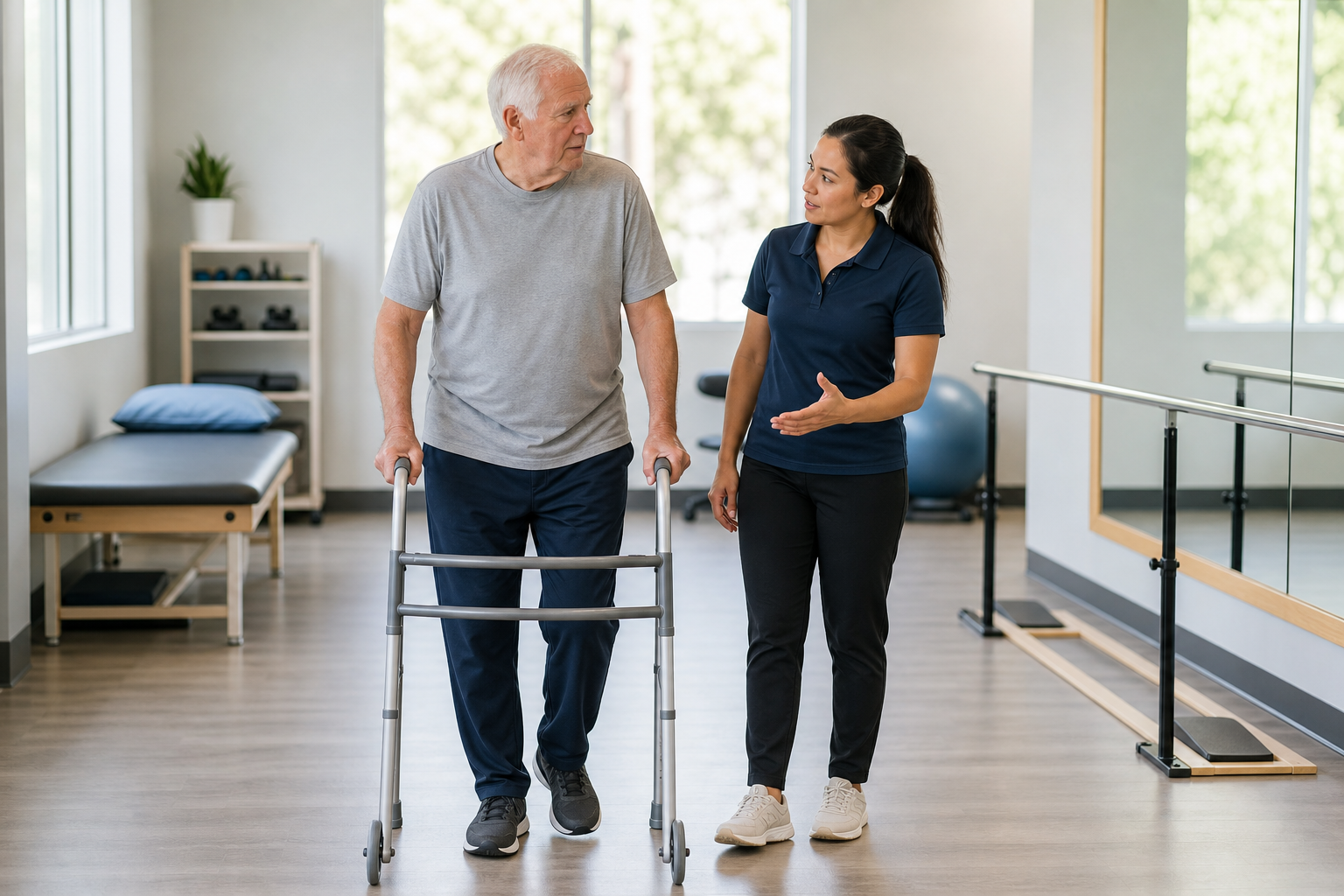
Fall Prevention Screening: What It Checks and When to Seek a Full Assessment
Fall prevention screening is an initial check of factors that may increase someone’s risk of falling. It can help determine whether a more detailed assessment, medical review, equipment evaluation, or prevention plan is appropriate. It is not the same as diagnosing the cause of a fall, and it does not guarantee that future falls will be prevented.
A full fall-risk assessment looks more broadly at the person, their environment, daily activities, and mobility equipment. The right next step depends on the concern, such as a recent fall, repeated near-falls, dizziness, a change in walking, or difficulty using a walker safely.
Key Takeaways
- Fall prevention screening can benefit individuals even if they have not fallen, addressing near-falls, balance changes, and mobility issues.
- A comprehensive fall-risk assessment provides a deeper understanding of contributing factors and personalized next steps.
- Common reasons for seeking screening include dizziness, gait changes, and fear of falling, which may require further evaluation.
- Physiotherapy can support mobility and balance, but medical assessment is crucial for unexplained or severe symptoms.
- Foundation Physiotherapy and Rehab offers complimentary consultations to help determine the best course of action.
Quick summary

- You do not need to have fallen to benefit from screening. Near-falls, balance changes, fatigue, or new difficulty walking can also warrant attention.
- A brief screen identifies whether further evaluation may be useful. A comprehensive assessment explores contributing factors in greater depth.
- Assessment may consider walking, transfers, balance, symptoms, home barriers, current equipment, daily routines, and personal goals.
- Screening does not automatically lead to a walker, wheelchair, vestibular therapy, or a particular exercise program.
- Sudden, severe, unexplained, or injury-related symptoms may require medical assessment in addition to physiotherapy support.
Fall Prevention Screening vs. a Full Fall-Risk Assessment
The terms “fall prevention screening” and “fall-risk assessment” are sometimes used interchangeably, but they describe different levels of evaluation. Screening is generally a starting point. It asks whether there are signs of increased risk and whether the person should receive more detailed attention.
A comprehensive assessment is more individualized. It examines how several factors interact, including movement ability, balance, transfers, dizziness, the home or community environment, footwear, daily activities, and the suitability of current mobility equipment. A mobility assessment should not be treated as a catalogue exercise. The aim is to understand how a person moves and what support is safe and practical for their life.
| Question | Initial screening | Full fall-risk assessment |
|---|---|---|
| Main purpose | Identify whether fall risk or a change in function deserves further attention. | Explore contributing factors and develop appropriate next steps. |
| Typical focus | Falls, near-falls, balance concerns, walking changes, dizziness, or difficulty with daily mobility. | Movement, gait, transfers, balance, symptoms, environment, equipment, routines, and goals. |
| What it can show | Whether additional assessment or referral may be appropriate. | Which factors may need to be addressed and what type of support may fit. |
| Possible next step | Prevention advice, monitoring, medical review, or a more detailed assessment. | Individualized rehabilitation, equipment trial, vestibular evaluation, environmental strategies, or coordinated care. |
Ontario describes falls prevention programs as potentially addressing strength, balance, mobility, and safer home environments. These are useful areas to consider, but a general program cannot replace an individualized clinical assessment when someone has complex symptoms or changing mobility needs. See the Ontario information on exercise and falls prevention programs for general program context.
When Should You Consider Fall Prevention Screening?

Consider seeking guidance when mobility or confidence has changed, even if no fall has occurred. A caregiver or family member may notice changes first, particularly if the person is holding onto furniture, avoiding stairs, walking less, or needing more help with transfers.
Common reasons to request screening include:
- A recent fall or repeated near-falls.
- New unsteadiness, a shorter walking distance, or a change in gait.
- Difficulty standing up, turning, getting in or out of bed, or transferring between surfaces.
- Dizziness, vertigo, visual-motion sensitivity, or balance problems.
- Fatigue or weakness that makes walking less consistent later in the day.
- Fear of falling that limits daily activities or community participation.
- Pain, discomfort, or uncertainty when using a cane, walker, wheelchair, or other equipment.
- A change in the home, work, or community environment that makes movement harder.
Dizziness and vertigo deserve particular attention because they may affect balance and confidence in different ways. Vestibular rehabilitation may be relevant for some people with dizziness, vertigo, BPPV, or balance disorders, but an assessment is needed to determine whether that approach fits the symptoms.
What a Physiotherapy-Based Fall-Risk Assessment May Consider
A physiotherapy-based assessment should connect clinical findings to the person’s actual routines. Someone may be steady in a treatment room but struggle on a busy sidewalk, in a narrow bathroom, on uneven ground, or when carrying groceries. The assessment therefore considers the relationship between the person, the task, the environment, and any device being used.
Movement and everyday function
The clinician may discuss or observe walking, turning, standing up, sitting down, transfers, balance reactions, and fatigue. The assessment may also consider how symptoms affect bathing, dressing, shopping, stairs, work, exercise, and other activities that matter to the individual.
Symptoms and health context
Information about dizziness, pain, weakness, numbness, vision changes, fatigue, previous injuries, and relevant health history can help determine what should be explored further. This information does not by itself identify the cause of a fall. Medical investigation may be needed when symptoms are new, unexplained, severe, or changing quickly.
Equipment and the environment
If someone uses a mobility device, fit and usability matter. Height, seat dimensions, turning, transfers, comfort, propulsion, controls, and the surfaces where the device will be used may all affect safety. A structured trial can reveal problems that are not obvious when equipment is viewed in isolation.
Foundation Physiotherapy and Rehab’s mobility assessment guidance explains how a person’s abilities, activities, environment, safety needs, and goals influence equipment decisions.
What May Happen After Screening?
Screening can lead to different next steps, depending on what is found and what the person needs. It may lead to prevention education and monitoring when concerns are mild and stable. It may also indicate that a broader mobility assessment, medical review, vestibular assessment, or coordinated care would be more appropriate.
- Prevention guidance: Advice about movement, strength, balance, activity pacing, or environmental safety may be appropriate for some people.
- Detailed mobility assessment: This may be useful when gait, transfers, balance, or current equipment are the main concerns.
- Vestibular assessment: Dizziness, vertigo, BPPV, or balance symptoms may require a more specific evaluation.
- Equipment trial: If a device may help, assessment and trial can guide fit and usability before a prescription is considered.
- Medical or multidisciplinary review: Repeated falls, unexplained episodes, injury, or symptoms outside physiotherapy’s scope may require another healthcare professional or more than one discipline.
A screening does not automatically result in a walker or wheelchair prescription. Equipment should be considered only when the assessment supports it, and the recommendation should reflect the person’s abilities, environment, activities, and goals. When a walker is being considered, walker prescription basics can help clarify why fit and function matter.
How to Prepare for a Fall Prevention Screening
You do not need to arrive with a perfect record of every symptom. However, a few practical details can make the appointment more useful and help the clinician understand what is happening outside the clinic.
- Record falls and near-falls: Note when they happened, what you were doing, the surface or environment, whether you were injured, and whether you felt dizzy or weak.
- Describe the change: Be ready to explain when walking, balance, endurance, transfers, or confidence began to change.
- Bring relevant information: Have a list of health conditions, medications, recent medical events, and questions to discuss with the clinician.
- Bring current equipment: If possible, bring the cane, walker, footwear, or other equipment involved in the concern. Seeing the device in use may help identify fit or usability issues.
- Explain daily challenges: Mention problems at home, outdoors, at work, on stairs, in the bathroom, or when moving in crowded spaces.
- Include caregiver observations: A family member can describe changes in walking, activity, confidence, or safety that may not be apparent during a short visit.
- Set a practical goal: For example, you may want to walk to the mailbox, transfer more safely, return to an activity, or feel more confident using existing equipment.
When Screening Is Not Enough
Screening is a useful starting point, but it cannot investigate every possible reason for a fall or balance change. If someone has been injured, has repeated unexplained falls, experiences sudden or severe dizziness, faints, develops an abrupt change in strength or coordination, or feels acutely unwell, seek prompt medical advice or emergency care as appropriate.
Physiotherapy can support movement, balance, equipment use, and rehabilitation, but it does not replace medical investigation when a symptom may indicate an urgent or broader health problem. Ontario’s public information also distinguishes eligibility and availability for publicly funded physiotherapy services, so those requirements should be checked directly rather than assumed. Details are available through Ontario’s physiotherapy information.
Finding Fall Prevention Support in London, Ontario
The best local starting point depends on the main concern. A mobility assessment may be appropriate when the issue involves gait changes, transfers, equipment, or difficulty moving safely through daily environments. Dizziness, vertigo, BPPV, and balance disorders may call for vestibular assessment. A medical or multidisciplinary referral may be more suitable when falls are unexplained, symptoms are complex, or urgent concerns are present.
Foundation Physiotherapy and Rehab is a London, Ontario clinic offering one-on-one, evidence-based care and individualized assessments. Its verified mobility services include mobility assessments, walker and wheelchair prescriptions, seating evaluations, powered mobility assessments, and ADP-authorized guidance. These services do not mean that every person will need a device or qualify for funding.
The clinic also offers a complimentary 10–15 minute consultation for prospective patients. That conversation can help clarify whether its mobility or vestibular services appear relevant before beginning care.
Fall Prevention Screening FAQ
Do I need to have fallen before seeking fall prevention screening?
No. A near-fall, new balance problem, gait change, dizziness, fatigue, fear of falling, or difficulty using equipment may be enough reason to ask for guidance. Early attention can help clarify whether a more detailed assessment is appropriate.
Does fall prevention screening guarantee that I will not fall?
No. Screening identifies concerns and possible next steps, but it cannot remove every risk or predict exactly what will happen. Fall risk can change with health, medication, environment, activity, and equipment.
Will screening automatically result in a walker or wheelchair prescription?
No. A device recommendation should follow an individualized assessment and, where appropriate, a trial of the equipment. The decision should account for fit, operation, transfers, environment, activities, and personal goals.
What should a caregiver bring to a fall-risk assessment?
Bring notes about falls and near-falls, changes in walking or confidence, current equipment, daily challenges, home barriers, and relevant questions. Caregiver observations can be especially useful when the person’s function varies throughout the day.
Can dizziness or vertigo be part of a fall-risk assessment?
Yes. Dizziness and vertigo can affect balance and movement, so they may be relevant to the assessment. A clinician can determine whether vestibular rehabilitation, medical review, or another next step is appropriate.
Conclusion: Choose the Next Step Based on the Risk Pattern
Fall prevention screening is best understood as a starting point, not a promise of prevention or a complete diagnosis. A fall is not required: a near-fall, change in gait, dizziness, reduced balance, fatigue, fear of falling, or equipment difficulty can justify seeking guidance.
Choose the next step based on the pattern. Mobility concerns may call for a broader assessment of movement, transfers, equipment, and environment. Dizziness or vertigo may warrant vestibular evaluation, while sudden, severe, unexplained, or injury-related symptoms may require medical assessment first.
For one-on-one mobility or vestibular guidance in London, Ontario, contact Foundation Physiotherapy and Rehab to learn about its individualized assessments and complimentary 10–15 minute consultation.