
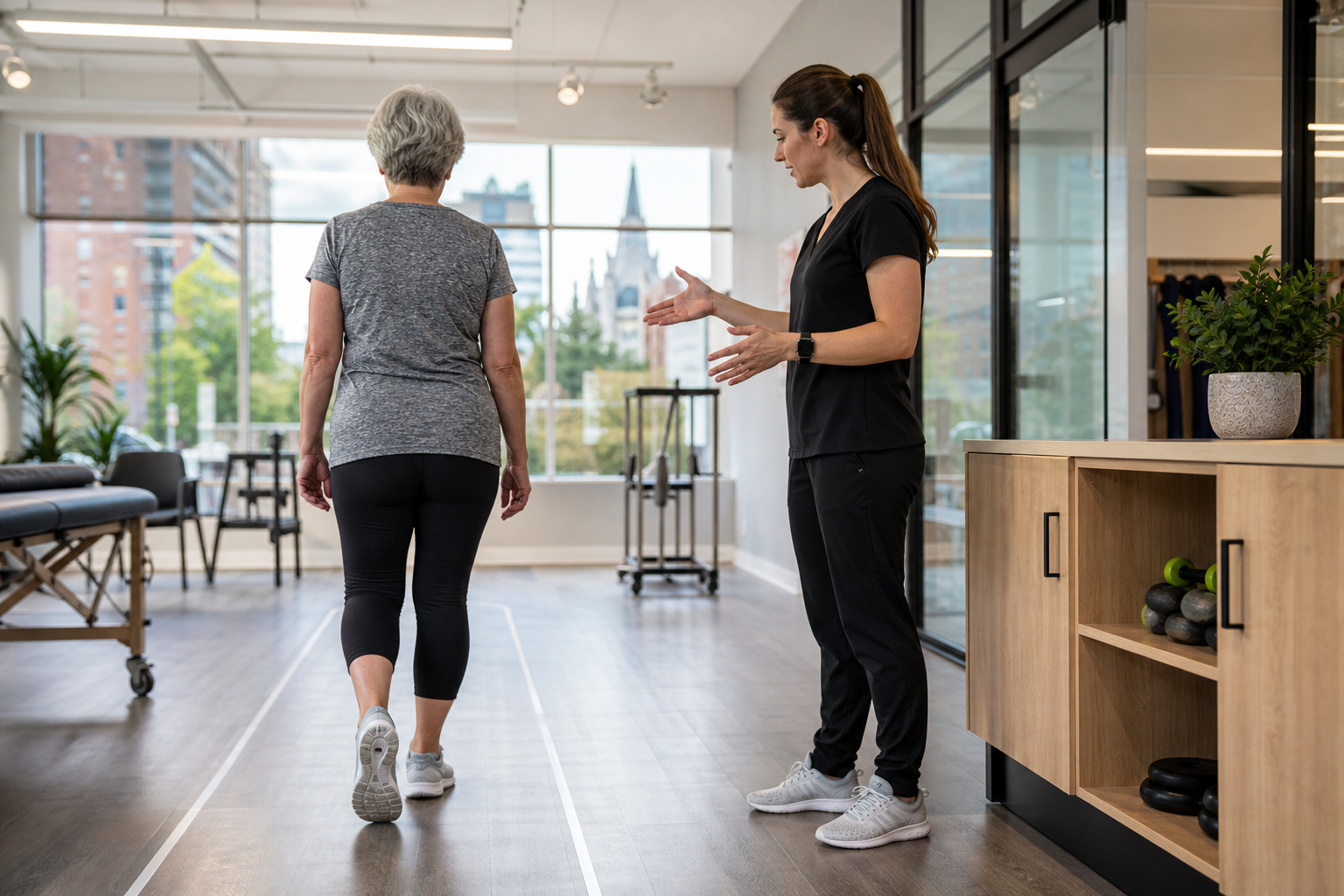
Gait Analysis: What It Assesses and Which Evaluation Is Right for You
Gait analysis can help you understand how your walking or running pattern relates to pain, balance, recurring injuries, footwear, or changes in movement. However, it is not always the best first assessment. The right starting point depends on whether your main concern is movement mechanics, an active injury, orthotics, or a broader change in mobility.
In London, Ontario, you may be deciding between gait or movement analysis, a physiotherapy assessment, a pedorthic assessment, or a mobility assessment. Understanding the differences can help you choose a provider conversation that matches your symptoms and goals.
Key Takeaways
- Gait analysis examines walking or running mechanics, but there is no single universal format or technology used by every provider.
- Recurring pain, injury recovery, or reduced function may call for a broader physiotherapy assessment rather than gait analysis alone.
- Footwear, orthotic, and lower-limb support questions may be better suited to a pedorthic assessment.
- Falls, balance changes, equipment discomfort, or difficulty moving through daily environments may require a mobility assessment.
- Before booking, prepare your symptoms, affected activities, footwear, orthotics or equipment, injury history, and desired outcome.
What Is Gait Analysis?
Gait analysis is an evaluation of how a person moves while walking or running. It may consider the timing and coordination of movement, lower-limb function, balance, symptoms, footwear, orthotics, and the activities that matter to the person being assessed.
The exact scope varies between providers. One assessment may focus on walking form, another on running-related movement, and another on lower-limb biomechanics or functional tasks. Some providers may use video or other measurement tools, while others may rely primarily on clinical observation and hands-on assessment. Ask what the appointment includes instead of assuming every gait analysis follows the same protocol.
Gait analysis is best understood as one lens on movement, not a guaranteed way to identify one exact cause of pain. Movement findings need to be considered alongside symptoms, injury history, strength, mobility, footwear, training demands, and personal goals.
When Gait Analysis May Help

A gait or movement assessment may be useful when you notice a persistent change in how you walk or run, especially if the change affects comfort, confidence, performance, or daily activity. Common reasons to seek an assessment include:
- Recurring lower-limb, hip, knee, ankle, or foot discomfort.
- A noticeable change in walking pattern after an injury or period of reduced activity.
- Running-related concerns, such as repeated injuries or difficulty increasing training.
- Balance changes or uncertainty about how your movement is affecting stability.
- Discomfort when wearing particular shoes, orthotics, or braces.
- Questions about whether your walking pattern or lower-limb mechanics should be assessed before changing footwear or inserts.
The purpose should be practical. You might want to understand why a movement feels different, identify factors to discuss during rehabilitation, or determine whether footwear and lower-limb support deserve closer attention.
Gait analysis cannot promise to prevent every injury, diagnose every condition, or prove that one movement pattern is the sole cause of pain. If symptoms are significant, worsening, or limiting normal activity, a broader physiotherapy assessment may be more appropriate. For readers considering orthotics, the decision should also account for symptoms, function, footwear, and the underlying goal. This guide on custom orthotics and posture may help frame that conversation.
Which Assessment Fits Your Concern?
These assessment pathways can overlap, but each starts with a different practical question. Use the comparison below as a starting point rather than a diagnosis.
| Primary concern | Likely assessment focus | Professional conversation to seek |
|---|---|---|
| Changed walking or running form | Movement patterns, lower-limb function, symptoms, activity demands, and functional goals | Gait analysis, movement analysis, or biomechanical assessment |
| Pain, injury, weakness, stiffness, or post-surgical recovery | Symptoms, mobility, strength, movement, recovery needs, and a plan for returning to activity | Physiotherapy assessment |
| Foot pain, walking difficulty, footwear concerns, or questions about inserts | Lower-limb biomechanics, footwear, fit, support, and individualized recommendations | Pedorthic assessment |
| Discomfort with orthotics, braces, or compression products | Fit, function, comfort, lower-limb needs, and whether the device suits the intended activity | Pedorthic or orthotics-focused assessment |
| Falls, balance changes, transfers, or difficulty using current equipment | The person, device, environment, safety needs, daily activities, and long-term goals | Mobility assessment |
A physiotherapy assessment may be the most useful starting point when pain or injury is central because it can place gait findings within a wider rehabilitation plan. A pedorthic assessment may be more suitable when your main question concerns footwear, custom inserts, bracing, or lower-limb support. A mobility assessment is different again: it focuses on safe and functional use of equipment in real environments.
Foundation Physiotherapy and Rehab’s clinic information describes one-on-one physiotherapy, individualized assessment and treatment planning, full biomechanical assessment, movement analysis, and pedorthic services. Its pedorthic services include lower-limb assessment, custom inserts, footwear recommendations, bracing, and compression stockings. These details do not mean that every concern needs all of those services. They show why an initial conversation can help match the assessment to the problem.
What to Expect During an Assessment
A useful assessment usually begins with a conversation about what changed, when it happens, and what you want to do more comfortably. Be prepared to describe whether symptoms occur during walking, running, stairs, standing, work, sport, or another activity.
The provider may then observe relevant movement and consider factors such as gait pattern, lower-limb function, balance, footwear, current orthotics or equipment, and the demands of your usual activities. The assessment should connect observations to practical next steps rather than treating one visible movement feature as a complete explanation.
If you choose physiotherapy, the discussion may extend beyond gait to pain, range of motion, strength, recovery after injury or surgery, exercise tolerance, and return-to-work, sport, or daily activities. If you choose pedorthics, the focus may include lower-limb biomechanics, fit, footwear, and support options. If you choose a mobility assessment, the provider may consider transfers, turning, home barriers, transport, device operation, and safety.
Ask the provider to explain what the findings mean in plain language. You should leave knowing what was observed, what remains uncertain, what options are being considered, and whether another type of assessment is needed.
How to Prepare for Gait Analysis or Movement Assessment
Good preparation helps the provider assess your real concern rather than a general version of it. Bring or write down the following:
- Your main symptoms: Note the location, timing, severity, and whether symptoms change with speed, distance, surfaces, stairs, or rest.
- Affected activities: Identify what has become difficult, such as running, walking to work, standing, playing sport, or completing household tasks.
- Footwear: Bring the shoes you commonly wear for the activity that causes concern. If relevant, bring older shoes that show unusual wear.
- Orthotics or devices: Bring current inserts, braces, canes, walkers, or other equipment if the assessment relates to them.
- History: Prepare a short record of injuries, surgery, relevant diagnoses, changes in training, and previous treatment.
- Your goal: Be specific about what you want to improve, whether that is walking farther, returning to running, reducing discomfort, improving confidence, or choosing suitable footwear.
Also ask whether you should wear clothing that allows the provider to observe the relevant areas comfortably. If your concern involves a particular activity, explain how that activity differs from ordinary walking.
Questions to Ask Before Booking in London, Ontario
Before choosing an assessment, ask questions that clarify its scope and what happens afterward:
- Do you assess walking, running, or both?
- Will the assessment consider pain, injury history, balance, and activity goals?
- Can you review my footwear, orthotics, brace, or current mobility equipment?
- What qualifications and experience does the assessing professional have for my concern?
- What does the fee include, and is follow-up included or booked separately?
- What happens if you find that I need physiotherapy, pedorthics, or a mobility assessment instead?
- Do I need a referral, or can I book an initial discussion directly?
- Will I receive practical recommendations, and how will they be reviewed over time?
Foundation Physiotherapy and Rehab is located at Unit 100, 540 Wharncliffe Road South in London, Ontario. The clinic offers a complimentary 10–15 minute consultation for prospective patients, which can be used to discuss the concern and clarify an appropriate care pathway before beginning treatment.
For equipment-related questions, it may also help to review assistive devices in London and the role of a structured mobility assessment. The right device depends on the person, the task, the environment, and the level of support required, not simply on a product category.
Frequently Asked Questions
Do I need a referral for gait analysis in London, Ontario?
Referral requirements can vary by provider, assessment type, funding arrangement, and insurance plan. Ask the clinic before booking. If you have significant symptoms or a complex medical history, a referral or coordination with another healthcare professional may still be useful even when it is not formally required.
How much does gait analysis cost?
There is no single standard price because the term can describe different assessments with different scopes, professional qualifications, and follow-up arrangements. Ask what the fee includes, whether the appointment is a standalone assessment, and whether recommendations or follow-up visits are separate. Do not compare prices without comparing the actual service provided.
Is running gait analysis different from walking assessment?
Often, yes. Running places different demands on speed, impact, training volume, footwear, and repeated loading than ordinary walking. Tell the provider which activity matters to you and whether the concern appears only while running. A walking assessment may not answer every question about running form or running-related pain.
Can gait analysis tell me whether I need orthotics?
It may provide useful movement information, but it should not automatically lead to orthotics. The decision should consider symptoms, function, footwear, lower-limb assessment, comfort, and your goals. A pedorthic assessment may be a better conversation when the main question involves custom inserts, footwear, bracing, or compression products.
Does gait analysis replace a physiotherapy assessment?
No. Gait analysis focuses on walking or running mechanics, while physiotherapy can address a wider range of issues, including pain, mobility, strength, injury recovery, post-surgical rehabilitation, and return to activity. Some people may benefit from both perspectives, while others need only the assessment that matches their primary concern.
When should I choose a mobility assessment instead of gait analysis?
Consider a mobility assessment when the main issue is safe movement through daily environments, falls, transfers, balance, fatigue, or difficulty using a cane, walker, wheelchair, or other device. Mobility assessments consider the relationship between the person, equipment, environment, safety needs, and long-term goals, rather than focusing only on walking mechanics.
Start With the Assessment That Matches the Problem
Gait analysis can be a useful way to examine walking or running mechanics, but it is only one possible starting point. Pain or injury may call for physiotherapy, footwear and orthotic questions may suit pedorthics, and equipment or safety concerns may require a mobility assessment.
Before booking, define the activity that is affected, bring relevant footwear or equipment, and ask what the assessment can and cannot answer. A clear conversation is more valuable than choosing a label without understanding the scope behind it.
London, Ontario readers can discuss their concern and possible next steps through the complimentary 10–15 minute consultation offered by Foundation Physiotherapy and Rehab.