
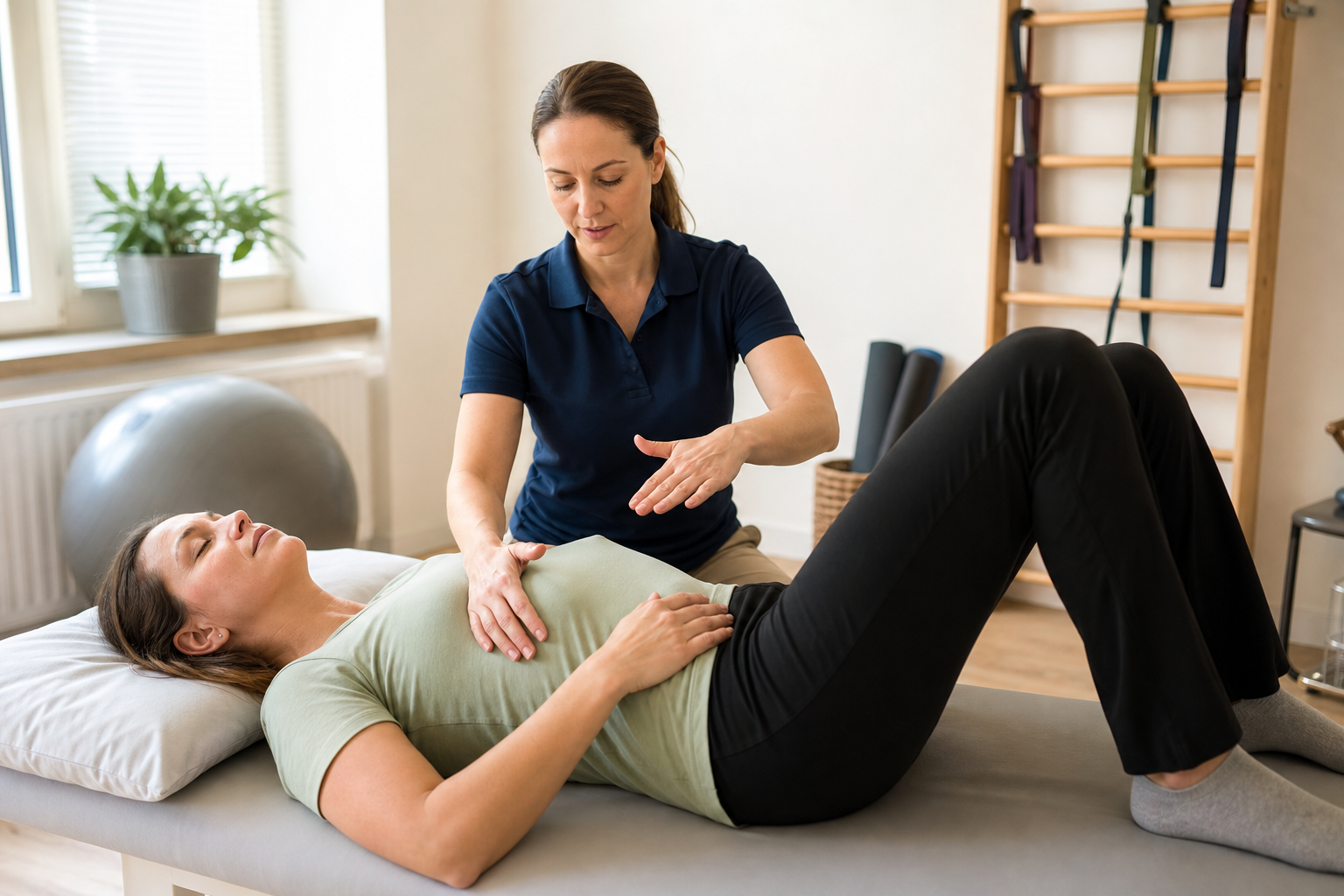
Neuromuscular Re-Education: How Physiotherapy Improves Muscle Control and Movement
Neuromuscular re-education is a physiotherapy approach that helps you improve how muscles activate, coordinate, and contribute to useful movement. It may involve guided exercises, movement practice, education, and, in selected cases, externally assisted muscle activation. The aim is not simply to make a muscle stronger, but to help your body use it with better control during meaningful activities.
The approach may be relevant to pelvic floor concerns such as incontinence, pelvic pain, postpartum recovery, or difficulty performing an effective contraction. It can also support broader rehabilitation after injury, surgery, or a period of reduced movement. The appropriate plan depends on an assessment of your symptoms, goals, movement, comfort, and response to care.
What Is Neuromuscular Re-Education?
In patient-friendly language, neuromuscular re-education is movement retraining. A physiotherapist helps you understand and practise how to activate a muscle, coordinate it with surrounding muscles, and use that control during posture, balance, breathing, lifting, walking, or another task.
For example, someone may know that they should contract a muscle but have difficulty finding the right muscle, relaxing it afterward, timing it with breathing, or using it during activity. Treatment may therefore focus on awareness, timing, coordination, endurance, strength, and functional control rather than on isolated effort alone.
Ontario’s current physiotherapy scope includes assessment of the neuromuscular system and the treatment, rehabilitation, prevention, or relief of physical dysfunction, injury, or pain. Neuromuscular re-education is an approach used within physiotherapy, not a separate qualification or treatment programme. The Ontario Physiotherapy Act provides the official statutory context.
Why Assessment Comes Before Treatment

The same symptom can have different contributing factors. Weakness, leakage, pain, poor balance, or difficulty controlling a movement does not identify one universal exercise or device. A physiotherapist needs to understand what happens, when it happens, what makes it easier or harder, and what you want to return to doing.
An initial assessment may consider your symptom history, relevant health history, movement limitations, daily activities, previous treatment, goals, and comfort preferences. Depending on the concern, the clinician may observe strength, mobility, coordination, balance, breathing, posture, or a specific functional task. The exact assessment should be explained to you, and you should be able to ask questions or pause.
Effective individualized assessment and personalized treatment planning connect the findings to your priorities. That is more useful than receiving a standard routine simply because your symptoms resemble someone else’s.
Active and Externally Assisted Approaches
The central decision is not whether one method is universally best. It is how different tools might fit together for your goals. Active neuromuscular re-education asks you to participate in the learning process. Externally assisted activation uses a device or other input to help produce muscle activity when appropriate.
| Approach | What you may do | Possible role | Why guidance matters |
|---|---|---|---|
| Active movement retraining | Practise targeted contractions, breathing, posture, balance, or functional movements. | Build awareness, control, coordination, strength, and confidence. | The exercise must match your ability, symptoms, and functional goal. |
| Education and self-management | Learn how symptoms, activity, pacing, technique, and recovery relate to movement. | Help you apply new skills outside the clinic. | Advice should be clear, realistic, and adjusted when your response changes. |
| Externally assisted activation | Receive an external stimulus while remaining an active participant in the broader plan. | Support muscle activation when voluntary recruitment is difficult or when an adjunct is appropriate. | A clinician should explain the rationale, alternatives, comfort considerations, and review process. |
External assistance should not be presented as a shortcut that makes active rehabilitation unnecessary. Learning to use a muscle during real movement generally requires practice, feedback, and progression. The right balance may change as your control improves.
How Neuromuscular Re-Education May Support Pelvic Floor Rehabilitation
Pelvic floor rehabilitation may be considered for pelvic floor dysfunction, incontinence, pelvic pain, prenatal or postnatal recovery, or difficulty coordinating pelvic floor muscles with breathing and daily activities. These concerns are personal, and symptoms alone do not show which treatment approach is appropriate.
A plan may include education about pelvic floor function, voluntary activation and relaxation, breathing coordination, graded strengthening, movement practice, and strategies for activities that trigger symptoms. Some people may need more emphasis on finding and releasing tension, while others may need support with endurance, timing, or progressive loading. The plan should reflect the assessment rather than assume that more contraction is always better.
Foundation Physiotherapy and Rehab describes its pelvic health physiotherapy as supporting pelvic floor dysfunction, incontinence, pelvic pain, and prenatal or postnatal recovery needs. That service context does not mean every patient receives the same treatment. It means the clinician can discuss which options may be relevant to your goals.
Where B-Pulse Chair Therapy May Fit
B-Pulse chair therapy is a non-invasive, externally delivered option intended to stimulate pelvic floor muscles while you remain fully clothed. The clinic describes typical sessions as 20 to 30 minutes. It may be considered when pelvic floor activation is difficult or when external stimulation could reasonably complement a broader rehabilitation plan.
B-Pulse chair therapy should be understood as one possible adjunct, not a universal recommendation or a replacement for assessment, education, exercise, or active movement practice. A physiotherapist should first discuss your goals, relevant history, comfort, and available alternatives. They should also explain how any device-based care connects to the skills you need in daily life.
External stimulation can produce muscle contractions without requiring the same voluntary effort as an exercise. However, the practical question is whether it helps you make progress toward a meaningful goal. Ask what you will practise actively, how the plan will be adjusted, and how the clinician will determine whether the approach remains useful.
Applications Beyond Pelvic Health
The same principles can apply to broader rehabilitation. After an injury or surgery, a person may need to restore strength, timing, balance, joint control, or confidence before returning to work, sport, or everyday tasks. Neuromuscular re-education may be part of a plan that combines movement retraining, therapeutic exercise, manual therapy, education, and gradual exposure to meaningful activities.
For example, rehabilitation may involve learning to control a previously painful movement, coordinate the muscles around a joint, improve balance during walking, or rebuild endurance for work tasks. The specific exercises and progression depend on the condition, precautions, current ability, and goal. The term describes the rehabilitation focus, not a fixed protocol for every patient.
What Treatment and Progression May Look Like
- Discuss symptoms and goals. Explain what is difficult, what affects your symptoms, and whether your priority is comfort, continence, walking, work, sport, lifting, or another activity.
- Assess relevant movement. The physiotherapist considers the information and movement findings that relate to your concern, while respecting your consent and comfort.
- Explain the rationale. You should understand why an exercise, movement strategy, education topic, or externally assisted option is being considered.
- Begin with a manageable intervention. This may include focused practice in the clinic and a small number of exercises or strategies to use at home.
- Monitor and adjust. The clinician may change the difficulty, repetitions, task, pacing, or treatment emphasis based on your response.
- Reassess function. Progress may involve better control, improved coordination, greater endurance, increased task difficulty, or a safer return to activities that matter to you.
There is no responsible single timeline that applies to everyone. A useful plan includes opportunities to review whether the treatment remains appropriate and what should happen if symptoms worsen, change, or fail to improve as expected.
Questions to Ask Before Starting
- What might be contributing to my difficulty with activation, control, coordination, or movement?
- What will the assessment include, and how will it relate to my goals?
- Why are you recommending this exercise, movement strategy, or device-based option?
- How will active exercise and education fit alongside any external stimulation?
- What should feel comfortable, and how can I pause or modify the treatment?
- How will we measure progress, and which functional changes are we looking for?
- When will the plan be reviewed or progressed?
- What alternatives are available if this approach is not suitable or does not feel helpful?
- Who should I speak with if my symptoms change or I have concerns between visits?
Clear answers matter because treatment should be collaborative. You do not need to choose a modality based on the name alone, and you should not feel pressured to continue an approach you do not understand or find acceptable.
Frequently Asked Questions
Is neuromuscular re-education the same as pelvic floor physiotherapy?
No. Pelvic floor physiotherapy is a broader area of care for pelvic floor concerns. Neuromuscular re-education is one approach that may be used within it to improve activation, coordination, relaxation, strength, or functional control.
Can it help if I have trouble activating my pelvic floor muscles?
It may be relevant, but symptoms do not determine suitability on their own. Assessment can help identify whether the main issue involves activation, coordination, tension, strength, pain, or another factor, and whether active practice, external assistance, education, or another strategy fits your needs.
Is B-Pulse chair therapy a replacement for pelvic floor exercises?
No. It is an external stimulation option that may be considered as an adjunct for selected patients. A complete plan may still include education, active pelvic floor practice, movement retraining, and progression toward daily activities.
What should I ask before trying external muscle stimulation?
Ask why it is being recommended, what alternatives exist, how it fits with active rehabilitation, what you should expect during treatment, how comfort and consent will be handled, and how progress will be reviewed. A clinician should make the reasoning clear before you decide.
Is neuromuscular re-education a separate physiotherapy licence in Ontario?
No. It is a treatment approach within physiotherapy. Ontario’s physiotherapy scope includes neuromuscular assessment and rehabilitation, but the phrase does not describe a separate licence, diagnosis, or provincial programme.
Conclusion: Choose the Approach That Matches Your Goals
Neuromuscular re-education is best understood as guided practice for improving useful muscle control. It may involve active exercises, education, movement retraining, functional tasks, and, when appropriate, externally assisted activation. The most suitable combination depends on your symptoms, assessment findings, goals, comfort, and response over time.
If you are considering pelvic floor rehabilitation or another movement-related physiotherapy approach, discuss the rationale rather than choosing a technique by name. Foundation Physiotherapy and Rehab in London provides one-on-one care, pelvic health physiotherapy, B-Pulse chair therapy, and a complimentary 10 to 15 minute consultation through Foundation Physiotherapy and Rehab.