
Pedorthic Assessment or Orthotics for Gait Concerns?
Choose a pedorthic assessment when you are unsure whether footwear, foot mechanics, gait, or lower-limb support is contributing to a movement problem. Orthotics may be recommended, but they are not automatic. Pelvic pain, leakage, pregnancy-related concerns, or other pelvic-floor symptoms usually call for individualized pelvic health assessment rather than buying inserts first.
Pedorthic Assessment vs. Orthotics: What Are You Actually Choosing?
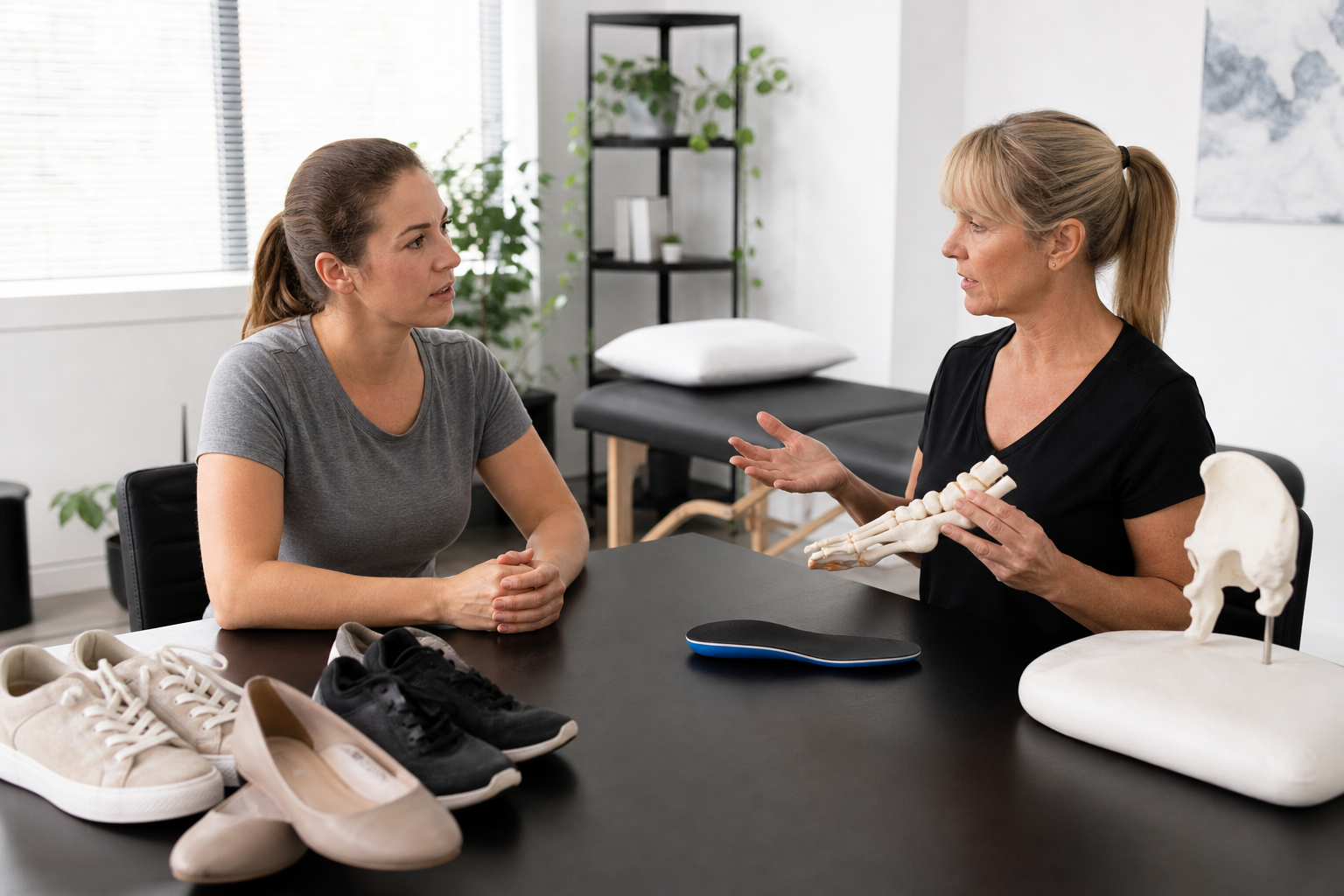
Pedorthic services evaluate foot and lower-limb function, footwear, gait, and related support options. A pedorthic assessment is the evaluation itself. Orthotics are one possible recommendation after the assessment, not a substitute for understanding the problem.
Pedorthic care can address foot, lower-limb, footwear, and gait questions. The assessment may consider how your arches behave under load, how you move, and whether an orthotic, footwear change, brace, or another option fits your current goals.
| Option | Purpose | What may be considered | Useful starting point when |
|---|---|---|---|
| Pedorthic services | Address foot, lower-limb, and footwear needs | Gait, foot mechanics, footwear, orthotics, bracing, and compression support | You have recurring lower-limb symptoms or need help choosing support |
| Pedorthic assessment | Clarify what may contribute to a movement or footwear problem | Symptoms, goals, shoes, movement, gait, and foot and lower-limb findings | You are unsure whether orthotics are appropriate |
| Orthotics | Provide insert-based support when indicated | Fit, footwear compatibility, comfort, activity demands, and response over time | An assessment identifies a reason to trial them |
| Footwear support | Match shoes to daily demands | Construction, fit, stability, activity, and insert compatibility | Your shoes are worn, poorly matched, or limiting movement |
| Physiotherapy | Improve pain, mobility, strength, movement, or function | Movement patterns, strength, flexibility, coordination, symptoms, and goals | Your main limitation is pain, weakness, pelvic-floor function, or broader movement |
If you are comparing assessment quality, fit, follow-up, and payment questions before ordering, read this guide to comparing custom orthotics assessment and follow-up.
When Should You Choose a Pedorthic Assessment First?
A pedorthic assessment is usually the better first step when you have a foot, footwear, or gait question but do not know which device or treatment fits. It can prevent you from spending money on an insert that does not suit your shoes, activity, symptoms, or rehabilitation goals.
- Choose assessment first if your gait has changed, your shoes wear unevenly, foot or lower-limb discomfort keeps returning, or you are unsure whether an insert is appropriate.
- Choose assessment first if over-the-counter inserts were uncomfortable, changed your symptoms, or did not fit your activities.
- Consider physiotherapy first if pain, weakness, restricted movement, poor balance, or difficulty returning to work, sport, or daily activity is the main problem.
- Consider pelvic health physiotherapy first if leakage, pelvic pressure, pelvic pain, bowel symptoms, sexual pain, or pregnancy or postpartum changes are the main concern.
- Consider coordinated care if a gait or footwear issue and a pelvic, hip, or lower-back movement concern are occurring together.
Someone whose feet hurt after long shifts may benefit from an assessment that considers work shoes and standing demands. Someone with postpartum leakage who also feels unsteady while walking needs the pelvic-floor concern assessed directly. One issue should not explain away the other.
Foundation Physiotherapy and Rehab offers a complimentary 10–15 minute consultation to help prospective patients understand an appropriate next step. If your uncertainty is specifically about fitting approaches, review custom orthotics fitting options.
What a Pedorthic Assessment May Clarify

A pedorthic assessment can help distinguish between footwear changes, an orthotic trial, exercise, gait work, or another form of care. The exact process varies, but a useful assessment connects its findings to what you need to do each day.
Your symptoms, activities, and goals
Expect questions about where discomfort occurs, when it starts, what changes it, and which activities are limited. Standing at work, running, walking with a stroller, climbing stairs, and returning to sport can create different support requirements.
The shoes you actually use
Bring everyday shoes, work footwear, runners, or sport shoes that matter to your routine. Fit, condition, structure, and available space can affect whether an insert or other support is practical.
Movement, gait, and lower-limb findings
A clinician may observe walking, standing, balance, or a task that reproduces your concern. The aim is not to label every unusual movement as a problem, but to determine whether a finding relates to symptoms, function, or your goals.
The next decision
You may be advised to trial an orthotic, change footwear, modify activity, begin exercise, work on gait or strength, or seek another assessment. The recommendation should explain its purpose and what would count as a useful response.
If an orthotic is recommended, fitting is only one part of the decision. Comfort, shoe compatibility, gradual adaptation, activity tolerance, and follow-up matter. For a detailed comparison of fitting and follow-up questions, use the orthotics guide linked above.
How Foot Mechanics and Gait Relate to Pelvic Concerns
Foot, lower-limb, hip, and pelvic movement can all be considered when you are trying to understand a broader movement concern. That does not establish that foot mechanics caused your symptoms or that orthotics will resolve them.
Pelvic pain, urinary or bowel symptoms, pelvic organ prolapse, sexual pain, pregnancy-related concerns, and postpartum changes require individualized assessment. You can review what to check before starting pelvic health physiotherapy if pelvic-floor symptoms are central to your decision.
Coordinated care may make sense when both pathways are relevant. Pelvic health physiotherapy can address pelvic-floor coordination and symptom management, while pedorthic care considers footwear or lower-limb support. Each assessment answers a different question.
Orthotics Are One Option, Not the Whole Plan

Orthotics do not automatically correct gait, alignment, or pain. They can change how the foot interacts with the shoe and ground, but the effect on walking varies with the person, device, footwear, activity, and problem being addressed.
No specific foot shape or condition universally requires orthotics. A professional may recommend them when the expected benefit fits your symptoms and functional goals, but other options may be more appropriate.
- Footwear changes: A better-fitting or more suitable shoe may solve a practical problem without an insert.
- Footwear modification: Shoe adjustments may help when the footwear itself contributes to discomfort or limited support.
- Exercise and strengthening: Strength, mobility, balance, or control work may address a movement limitation more directly.
- Gait retraining: A walking or running pattern linked to symptoms may respond to practice and progressive loading.
- Activity modification: Changing distance, intensity, surfaces, or recovery time can help while the problem is assessed.
- Monitoring: Tracking triggers and function may be reasonable when symptoms are mild and stable.
An unusual arch, uneven shoe wear, or visible alignment difference is a reason to ask a useful question, not proof that you need custom orthotics. The key issue is whether the finding relates to your symptoms and improves your ability to do something that matters to you.
Pedorthist, Physiotherapist, or Both?
A pedorthic assessment focuses on the relationship between your feet, footwear, lower limbs, gait, and support options. Orthopedic and musculoskeletal physiotherapy addresses pain, injury, mobility, strength, movement dysfunction, and recovery after surgery more broadly.
Pelvic health physiotherapy addresses pelvic-floor and pelvic symptoms through a private, individualized process with clear explanations, consent, and goals. Foundation Physiotherapy and Rehab describes its care as one-on-one and evidence-based, with thorough assessment and personalized treatment planning.
Podiatrists and physiotherapists may recommend orthotics in some situations, but neither profession recommends them for every person with foot pain or an unusual gait. The decision depends on scope, assessment findings, goals, and whether another option better fits the problem.
Seeing both professionals can be reasonable when pelvic symptoms occur alongside a separate or contributing footwear and gait concern. The purpose is coordinated care, not collecting devices or repeating assessments.
When Not to Start With Orthotics
Do not use an orthotic purchase as a substitute for assessment when your main concern is urinary leakage, bowel dysfunction, pelvic pressure, sexual pain, pregnancy-related symptoms, or postpartum recovery. Pelvic-floor, pregnancy-related and severe or unexplained pelvic symptoms should be discussed with an appropriate healthcare professional, including pelvic health physiotherapy where relevant.
Pelvic-floor physiotherapy can be a non-surgical option for many people with stress urinary incontinence. If you are unsure how to interpret pelvic symptoms or which type of care fits, discuss them with an appropriate healthcare professional before choosing inserts.
If you are unsure what a pelvic physiotherapy assessment involves, read about what may happen during a pelvic exam at physio to prepare questions about privacy, consent, and alternatives.
Questions to Ask Before Booking in London
Use these questions to establish whether you are booking an evaluation, device fitting, physiotherapy, or a combination:
- What problem is the assessment designed to clarify?
- Will the provider consider my everyday, work, or sport footwear?
- What findings would support orthotics, and what would support another option?
- Could footwear changes, exercise, gait retraining, or activity modification be reasonable alternatives?
- How will comfort, function, and response be monitored?
- If I have pelvic symptoms, should I arrange pelvic health physiotherapy or medical assessment as well?
Bring a short symptom history, the shoes you use most, information about your work or sport demands, and relevant treatment or surgery details. You do not need to decide in advance that orthotics are the answer. For detailed questions about fitting, follow-up, and payment, use the orthotics comparison guide before booking.
Choosing Your Next Step in London, Ontario
Choose assessment-first when you need help understanding a foot, footwear, gait, or lower-limb problem. Choose pelvic-health-first when pelvic-floor symptoms are the main issue. Choose orthopedic physiotherapy when pain, weakness, injury, or movement limitation is the central barrier. When concerns overlap, coordinated care can be more useful than choosing one explanation too early.
Foundation Physiotherapy and Rehab offers a complimentary 10–15 minute consultation for prospective patients seeking direction before care. In London, ask about the most suitable pathway through its pedorthic services, pelvic health physiotherapy, or orthopedic and musculoskeletal physiotherapy.