
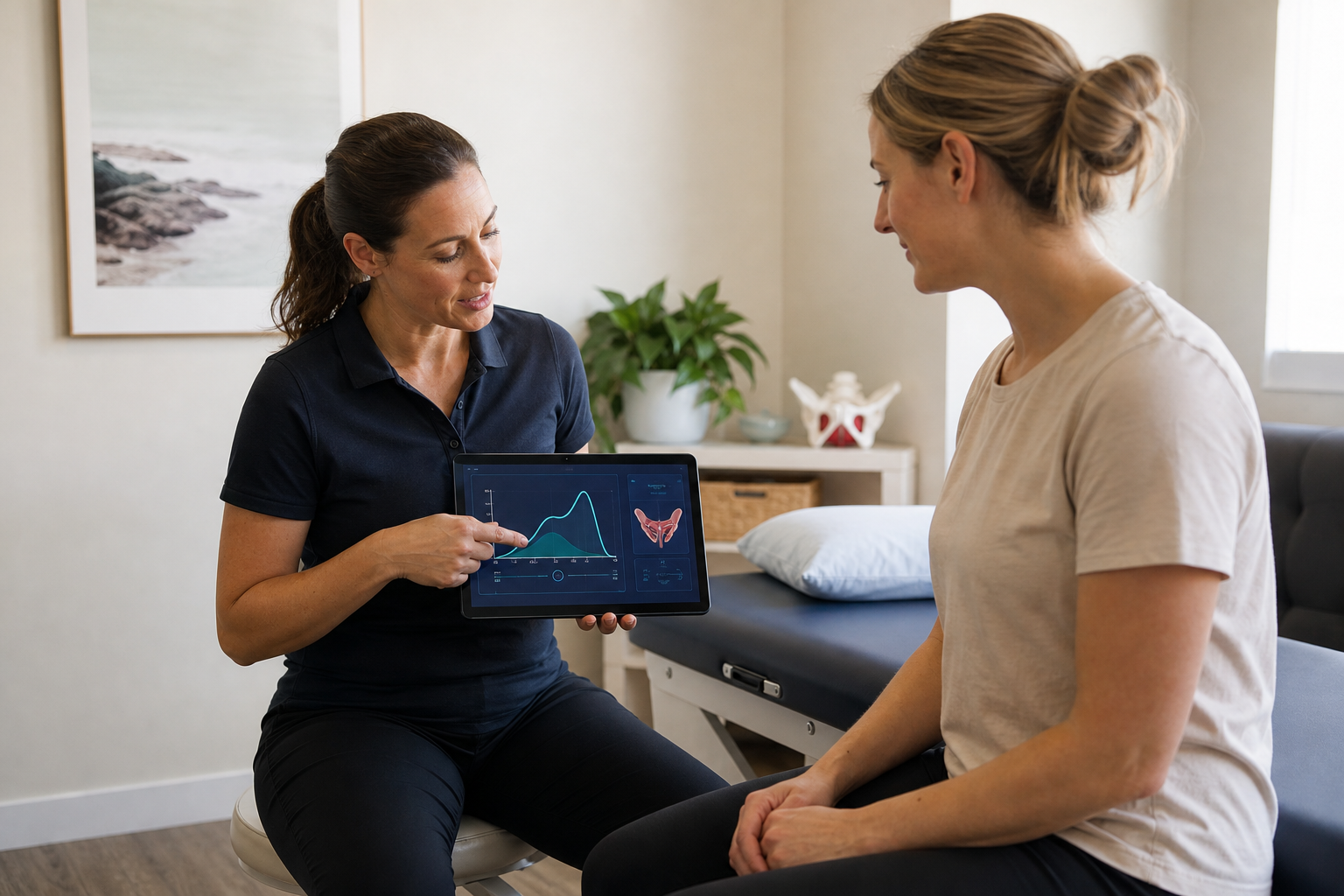
Pelvic Floor Biofeedback: How It Supports Muscle Training and What to Ask Before Starting
Pelvic floor biofeedback is a feedback tool that helps you and a clinician understand how your pelvic floor muscles are working. It may make it easier to identify a contraction, recognize unwanted bearing down, or practise coordination, but it is not a diagnosis or guaranteed cure for leakage or pelvic pain.
The right approach depends on your symptoms, goals, muscle control, comfort, and assessment findings. Biofeedback may be used alongside pelvic floor muscle training, exercise, education, and relaxation strategies rather than as a replacement for individualized care.
What is pelvic floor biofeedback?
Biofeedback gives you information about a body process that is difficult to see or feel directly. In pelvic health care, that information may help you understand how well the pelvic floor muscles are contracting, relaxing, or coordinating during a task.
Official Alberta health information describes biofeedback as a way to provide information about pelvic floor contraction and notes that it may help people learn pelvic floor exercises. The specific method can vary. A clinician may discuss external feedback, internal feedback, or a particular monitoring system depending on your needs and the equipment available.
Terms such as pelvic floor muscle biofeedback, EMG biofeedback, and surface EMG may refer to different ways of observing muscle activity. Ask the provider exactly what technology is being used and what it can show.
Biofeedback does not identify every cause of urinary leakage, pelvic pain, pressure, or difficulty with muscle control. Its role is more focused: it can support learning and awareness while a qualified clinician connects muscle activity to your symptoms and functional goals.
When might pelvic floor biofeedback be considered?

Someone may ask about biofeedback when they are unsure how to find the pelvic floor muscles, cannot tell whether they are contracting or relaxing correctly, or feel that their technique changes from one attempt to the next. It may also be considered when coordination is more important than simply building strength.
For people experiencing urinary leakage, feedback may help confirm whether the pelvic floor muscles are recruiting appropriately during supervised training. The goal is not to use a device for its own sake, but to learn a skill that may support activities such as coughing, lifting, exercising, or changing position. For more context on biofeedback for stress incontinence, consider how objective assessment and supervised pelvic floor muscle training fit together.
Biofeedback is not automatically appropriate for every symptom pattern. Someone with pelvic pain, muscle overactivity, difficulty relaxing, recent surgery, pregnancy-related concerns, or symptoms that have not been medically assessed may need a different starting point or coordinated care.
Pelvic floor exercises, biofeedback, and B-Pulse chair therapy
These options can sound similar because they may all be discussed in relation to pelvic floor muscle control. Their purpose and the role you play during treatment are different.
| Option | Main purpose | Your participation | What to clarify |
|---|---|---|---|
| Pelvic floor exercises | Practise voluntary contraction, relaxation, strength, endurance, or coordination. | You actively perform the movement with guidance and usually a home plan. | Which muscles should work, what should relax, and how will progress be checked? |
| Pelvic floor biofeedback | Provide information about muscle activity so contraction, relaxation, or coordination can be understood more clearly. | You actively practise while receiving feedback from the agreed method. | What does the method measure, and how will it affect the treatment plan? |
| B-Pulse chair therapy | Provide external pulsed electromagnetic stimulation intended to support pelvic floor and neuromuscular activation. | You remain seated while the external device provides stimulation, subject to clinical screening. | Why is it being considered, what are the alternatives, and how will its contribution be measured? |
B-Pulse chair therapy should not be described as biofeedback. The clinic describes it as a non-invasive pelvic floor and neuromuscular stimulation option. Its external stimulation and biofeedback have different mechanisms, even if both may be discussed as part of broader rehabilitation. You can review B-Pulse chair therapy when comparing external stimulation with active pelvic floor training.
None of these options should be selected solely because it sounds more advanced. Ask what problem the treatment is intended to address, what you will need to do during and between appointments, what outcome would indicate progress, and when the plan will be reassessed.
What may happen during a pelvic health assessment?
A pelvic health assessment should begin with a detailed conversation, not an assumption about what your symptoms mean. You may discuss leakage, urgency, bowel or bladder habits, pelvic pain, sexual symptoms, pregnancy or childbirth history, surgery, medical conditions, activity limitations, and the situations you want to improve.
At Foundation Physiotherapy and Rehab, the pelvic health process is described as beginning with a discussion of symptoms and medical history, followed by an external and, when appropriate, internal assessment. An internal assessment is not automatically required. If it is proposed, the clinician should explain why, what it involves, what information it may provide, and what alternatives are available before asking for consent.
The clinic’s pelvic health physiotherapy service may include pelvic floor muscle retraining, exercise, biofeedback, manual therapy, and relaxation techniques. You can ask questions, pause, decline an examination, or request another way to assess progress.
How biofeedback may fit into a broader treatment plan
Biofeedback may be one part of a plan that includes pelvic floor muscle retraining, exercise prescription, relaxation practice, education, activity changes, and review of bladder or bowel habits when relevant. Official Alberta health information lists pelvic floor muscle training, lifestyle changes, biofeedback, bladder training, medication, pessaries, and surgery among possible urinary incontinence management options, depending on the cause.
A useful plan connects treatment to a meaningful outcome. That might be fewer leakage episodes, greater confidence during activity, improved ability to relax the pelvic floor, less discomfort, better control during transfers, or returning to a valued activity. The specific measure should reflect your symptoms and goals rather than simply counting sessions.
Some people tighten surrounding muscles, hold their breath, or bear down instead of coordinating the pelvic floor. Others focus on strengthening when their main difficulty is excessive tension or poor relaxation. Feedback and clinical examination can guide the conversation, but they do not replace clinical judgment.
Questions to ask before starting
- What may be contributing to my symptoms, and what are we trying to improve first?
- Would biofeedback help me understand contraction, relaxation, or coordination?
- What type of feedback or monitoring method do you use? Is it internal, external, or surface-based?
- What will I need to do during the session, and what practice will I do between visits?
- How will you protect my privacy and obtain consent before any examination or treatment?
- How will we measure progress, such as changes in leakage, discomfort, confidence, function, or muscle control?
- Could pelvic floor exercises, relaxation training, education, or another approach be a better first step?
- How does biofeedback compare with B-Pulse chair therapy for my goals?
- When will we reassess the plan, and what will we do if progress is limited?
- Do my symptoms require assessment by another healthcare professional?
What to confirm with a London pelvic health physiotherapist
People searching locally may use terms such as pelvic floor biofeedback, pelvic floor physiotherapy, or EMG biofeedback. Foundation Physiotherapy and Rehab in London, Ontario, states that biofeedback may be included within individualized pelvic health care, but the supplied clinic information does not verify a particular EMG or surface EMG system. Confirm the available technology, proposed assessment, and connection to your goals before deciding.
The clinic offers a complimentary 10 to 15 minute consultation for prospective patients who want direction before beginning care. Use it to describe your main concern, ask whether pelvic health physiotherapy may be appropriate, and clarify what the first full assessment would involve. A consultation does not replace a full clinical assessment or medical care when needed.
Frequently asked questions
Is pelvic floor biofeedback the same as Kegel exercises?
No. Kegel exercises are voluntary pelvic floor contractions. Biofeedback provides information while you practise, which may help you understand whether you are recruiting, relaxing, or coordinating the muscles as intended.
Can pelvic floor biofeedback help with urinary leakage?
It may support supervised pelvic floor muscle training for some people with urinary leakage, particularly when technique or muscle recruitment is difficult to understand. It is not a guaranteed cure, and leakage can have different causes.
Does pelvic floor biofeedback require an internal assessment?
Not necessarily. The method depends on your symptoms, goals, the clinician’s approach, and available technology. An internal assessment should be explained clearly and performed only with informed consent.
Is B-Pulse chair therapy a form of pelvic floor biofeedback?
No. B-Pulse chair therapy is described as external pulsed electromagnetic stimulation for pelvic floor and neuromuscular activation. Biofeedback provides information about muscle activity.
How can I confirm whether a clinic offers EMG biofeedback?
Ask which equipment and feedback method the clinic uses, whether it is external or internal, what it measures, and how the information affects treatment. Do not assume that every pelvic health clinic uses a particular EMG system.
When should pelvic floor symptoms be assessed by another healthcare professional?
Seek additional medical guidance when symptoms are new, severe, worsening, associated with concerning bleeding or infection symptoms, or outside the physiotherapist’s scope. Pelvic health physiotherapy does not replace medical, gynecologic, urologic, or obstetric assessment when needed.
Choose feedback that supports your goals
Pelvic floor biofeedback can make muscle activity easier to understand during supervised training. Its usefulness depends on the question being addressed, the feedback method, your comfort and consent, and whether progress is connected to an outcome that matters to you.
Before choosing between exercises, biofeedback, and external stimulation, start with a thorough assessment and ask how each option would fit your symptoms. For readers in London, Ontario, Foundation Physiotherapy and Rehab offers a complimentary 10 to 15 minute consultation to discuss pelvic health physiotherapy options and possible next steps before starting care.